Date: 7 August 2026
Occasion: Fifth Anniversary of the Taliban’s Return to Power in Afghanistan on 15 August 2021
Type of Event: Protest Dialogue and Advocacy Discussion
Organizers:
* Women’s Justice Movement
* United Afghan Women’s Movement for Freedom
* Afghan Women’s Movement for Justice and Awareness
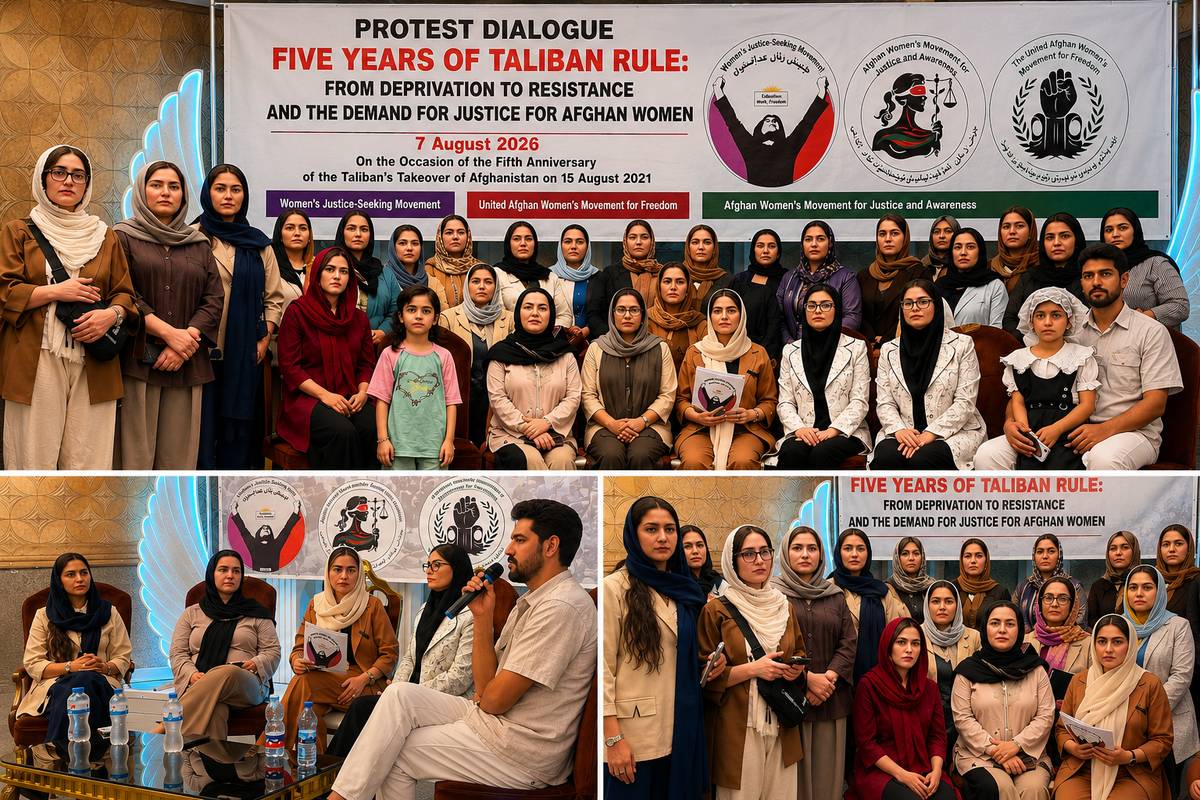
As the fifth anniversary of the Taliban’s return to power in Afghanistan approaches, a protest dialogue entitled “Five Years of Taliban Rule: From Deprivation to Resistance and the Demand for Justice for Afghan Women” was held on 7 August 2026, bringing together human rights defenders, political and social researchers, representatives of women’s movements, and civil society activists.
The dialogue provided an opportunity to reflect on the past five years from the perspective of Afghan women and girls—a period marked by widespread restrictions on education, employment, social and political participation, freedom of movement, and many other fundamental rights.
The purpose of the dialogue was not simply to recount the hardships and restrictions imposed on women. It also sought to document and amplify the voices of Afghan women as they have experienced these five years—from deprivation and repression to resistance and perseverance.
The central message of the dialogue was clear: Afghanistan women are not asking for pity. They are demanding rights, freedom, human dignity, equal participation, and justice.
Participants emphasized that the situation of Afghanistan women cannot be treated merely as a “women’s issue.” The exclusion and systematic restriction of half of Afghanistan’s population have profound political, social, economic, and humanitarian consequences for the entire country and are directly connected to Afghanistan’s future and stability.
Opening of the Dialogue
The program opened with remarks by Shabana Shabdiz, the moderator of the dialogue. In welcoming the guests and participants, she highlighted the significance of the fifth anniversary of 15 August 2021 and described the occasion as an opportunity to reflect on what Afghan women and girls have endured during the past five years.
“Today, as we approach the fifth year of Taliban rule in Afghanistan, we have gathered to reflect on five years that, for many Afghan women, have been marked by deprivation, restrictions, lost opportunities, and the suppression of hope.”
Shabdiz explained that the dialogue would examine the past five years from three interconnected perspectives: deprivation, resistance, and the demand for justice.
She emphasized that the purpose of the gathering was not merely to speak about suffering and restrictions, but to amplify the voices of women who, despite immense pressure and hardship, have continued to stand for their rights and human dignity.
What Happened to Afghan Women During Five Years of Taliban Rule?
The first section of the dialogue focused on the situation of Afghan women and the social and political consequences of Taliban policies.
Mehrzad Azimi – Researcher on Afghanistan’s Political and Social Affairs
Mehrzad Azimi, a researcher specializing in Afghanistan’s political and social affairs, examined the social and political consequences of restrictions imposed on women.
He emphasized that excluding women from education, employment, and public life affects far more than the individual rights of women. It has broad consequences for families, the economy, human capital, social development, and Afghanistan’s political future.
According to Azimi, a society that deprives half of its population of educational, economic, and social opportunities cannot achieve sustainable development.
He also addressed the resistance of Afghan women, noting that despite severe pressure and geographical and social fragmentation, women have not remained silent during the past five years.
Azimi stressed the importance of education, awareness, and capacity-building for women, describing these as among the most important foundations for preparing women to play a meaningful role in Afghanistan’s future.
He argued that women who are fighting for their rights today must also have access to the knowledge and skills necessary to help build a different future.
Bibi Mah Ahmadi – Human Rights Defender
Bibi Mah Ahmadi, a human rights defender, expressed appreciation for the struggles and resistance of Afghan women and emphasized the importance of solidarity and unity among women.
Referring to Afghanistan’s traditional and patriarchal social structures, she said that women need empathy, trust, and cooperation in order to defend their fundamental human rights.
She stressed that the struggle for women’s rights should not be limited to individual or fragmented efforts. The shared experiences and suffering of Afghan women can provide a foundation for broader solidarity and the development of a common voice.
Ahmadi also referred to the political developments that preceded the Taliban’s return to power and highlighted the responsibility of the international community for the consequences of those developments.
In her view, Afghanistan’s crisis has not remained within the country’s borders. Migration, displacement, and humanitarian crises resulting from the situation in Afghanistan continue to affect the lives of millions of people both inside and outside the country.
Adila Ayoub Hakimi – Head of the Afghan Women’s Movement for Justice and Awareness
Adila Ayoub Hakimi, head of the Afghan Women’s Movement for Justice and Awareness, expressed deep concern about the situation of Afghan women and girls and described women’s resistance as one of the most important social capacities confronting exclusion and repression.
While supporting women’s struggles, she emphasized the importance of transparency, accountability, integrity, and solidarity within protest movements.
According to Hakimi, women’s advocacy can have a greater impact when it is based on clear principles, mutual trust, and shared objectives.
She also warned against allowing women’s struggles to become a platform for individual or group interests. Maintaining the trust of women and society, she emphasized, is one of the most important responsibilities of protest movements.
Despite the many challenges, Hakimi stressed the importance of maintaining hope. She argued that the future of the women’s struggle depends on continued efforts, solidarity, and a sustained belief in freedom and justice.
Banafsheh Zafari – Representative of the United Afghan Women’s Movement for Freedom
Banafsheh Zafari, a representative of the United Afghan Women’s Movement for Freedom, shared aspects of her personal experience over the past several years, including her experiences of detention, threats, and pressure related to her civil and human rights activities.
She also spoke about forced migration and the difficulties faced by Afghan women and families outside Afghanistan.
Zafari emphasized that for many women activists, leaving Afghanistan was not a voluntary choice but the result of circumstances that forced them away from their homes, work, communities, and previous lives.
Referring to the situation of Afghan migrants in Iran, she discussed challenges including limited access to employment, housing, banking services, and certain social services, describing these difficulties as part of a broader chain of suffering that often continues even after migration.
One of her major concerns was the long-term impact of educational deprivation on future generations.
She warned that the continued exclusion of children and young people from education could have profound consequences for Afghanistan’s future and could leave an entire generation facing serious limitations in knowledge, skills, and opportunities.
For this reason, she emphasized the importance of online education and other alternative forms of learning, stressing that Afghan society must continue to find ways to preserve knowledge and educational opportunities under all circumstances.
Five Years of Deprivation — But Not Five Years of Silence
One of the central themes of the dialogue was that the past five years should not be recorded merely as five years of deprivation and repression.
Alongside restrictions, Afghan women have continued to resist in different forms.
Civil protests, media activism, underground and online education, documentation of human rights violations, human rights advocacy, the creation of support networks, and efforts to preserve the voices of Afghan women at national and international levels have all been forms of resistance.
This resistance has demonstrated that excluding women from public life, even under extreme pressure, cannot eliminate their aspirations for freedom and justice.
During these years, Afghan women have not merely spoken about their deprivation. They have worked to preserve their narratives, document their experiences, and demonstrate that Afghanistan’s future cannot be defined without their participation.
The Danger of Normalizing the Deprivation of Women
A major concern raised during the dialogue was the danger of normalizing the situation of Afghan women.
Participants stressed that the prolongation of a human rights crisis must not cause it to be accepted as a normal part of life in Afghanistan.
Five years of deprivation do not make deprivation legitimate.
Five years of excluding women do not make their exclusion acceptable.
Participants argued that the continuation of this situation requires stronger international attention and that women’s rights must remain central to discussions concerning Afghanistan.
They also emphasized that any vision for Afghanistan’s future that does not take into account the rights and role of women will inevitably be incomplete.
Message of the Dialogue to the International Community
Throughout the event, participants emphasized the responsibility of the international community toward Afghan women.
They noted that Afghan women have repeatedly explained their situation, documented violations of their rights, spoken publicly about their experiences, and paid significant personal costs in defending their fundamental freedoms.
Therefore, the central question today is not simply whether the international community is aware of the situation of Afghan women. The more important question is **how the international community will respond**.
Participants emphasized that the exclusion of half of a country’s population from education, employment, public life, and social participation cannot become a permanent reality, and that the passage of time must not reduce international attention to the situation.
Protest Poetry: A Voice of Pain and Resistance
During another segment of the program, Shahbano Nouri presented her protest poem.
This part of the program connected political and social analysis with poetry and emotion, presenting another dimension of the pain, protest, resistance, and hope of Afghan women.
Poetry was not merely a cultural component of the event. It formed part of the broader narrative of women’s resistance.
That resistance does not exist only in the streets or in political activism. It also continues through poetry, art, writing, education, media, and the personal stories of Afghan women.
A Shared Message: “Recognize Gender Apartheid”
At the conclusion of the program, participants reiterated their call for the international community to pay serious and sustained attention to the situation of Afghan women and girls.
They called for the recognition of the systematic and institutionalized exclusion of women and girls in Afghanistan as **gender apartheid** and stressed the need for meaningful international action.
The final group photograph symbolized solidarity and the continuation of Afghan women’s resistance—women who, despite five years of pressure and deprivation, continue to raise their voices.
Closing Remarks
In her closing remarks, moderator Shabana Shabdiz thanked the guests, speakers, and participants and emphasized that what had been heard throughout the dialogue demonstrated that the situation of Afghan women is not merely a women’s issue.
“What we heard today demonstrates that the situation of Afghan women is not simply a women’s issue; it is an issue directly connected to Afghanistan’s future, development, justice, freedom, and human rights.”
She emphasized that the past five years have been years of deprivation for Afghan women, but they have also been years of resistance and perseverance.
She added:
“Afghan women have demonstrated that they will not accept being erased from society, and they will continue to struggle for their rights and human dignity.”
Shabdiz concluded by expressing appreciation to Afghan women, human rights defenders, journalists and media organizations, civil society actors, and everyone who has listened to and supported the voices of Afghan women.
She ended with a message that echoed throughout the dialogue:
“The voices of Afghan women cannot be silenced.”
15 August 2026
Afghan Women’s Protest Movements
Five Years of Taliban Rule: From Deprivation to Resistance — From Silence Imposed to Voices Rising for Justice.
Share: