Over the past five years, women in Afghanistan have experienced different forms of resistance and struggle in the face of widespread restrictions and their gradual exclusion from education, social life, and public spaces. These efforts have ranged from street protests and advocacy to cultural activities and the creation of independent spaces for learning and raising awareness.
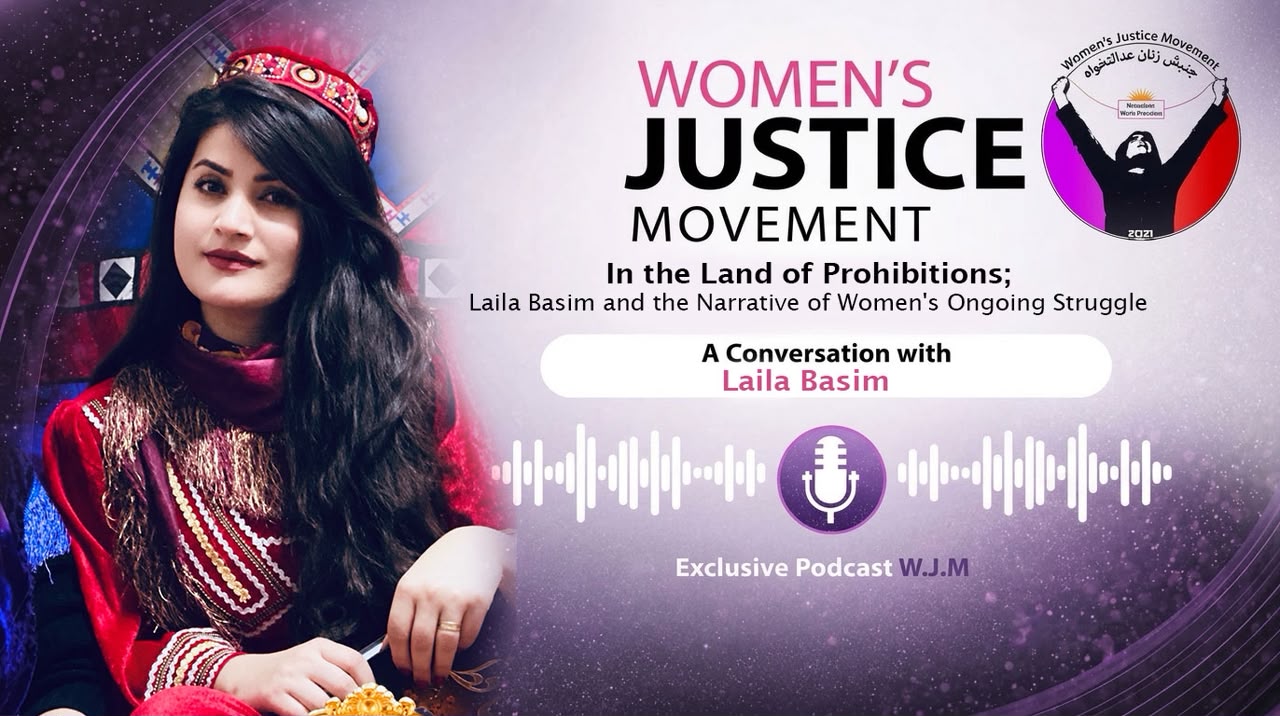
Laila Basim is one of the women who has been active in this struggle, participating in women’s protests while also working in the cultural sphere. The establishment of the Women’s Library in Kabul, at a time when women and girls were being denied access to education and social participation, was one of the notable initiatives she undertook alongside her fellow activists. The space later faced restrictions and pressure.
In this interview, we speak with Laila Basim about her personal journey and social activism, her experiences of women’s protests, the establishment of the Women’s Library, the pressure placed on cultural and protest activities, and the future of women’s struggles in Afghanistan.
Women’s Justice Movement: Ms. Basim, to begin our conversation, we would like our readers to get to know Laila Basim, a woman who, over the past several years, has worked alongside other women in Afghanistan to defend women’s rights to education, freedom, and social participation. If you were to tell our readers about yourself, your background, and the path you have taken, where would you begin?
Basim: My name is Laila Basim. I am a woman born in Afghanistan, with a bachelor’s degree in economics and several years of professional experience in finance and administration. In recent years, I have devoted my efforts and attention to cultural, civil society, awareness-raising, and media activities because I believe that the roots of change and lasting progress in a society lie in awareness, knowledge, and standing firm in defence of human rights.
With the Taliban’s return to power and the collapse of everything our generation had built, achieved, and dreamed of, I, like thousands of other women in Afghanistan, faced a crossroads: accept isolation and surrender, or stand firm. I chose the latter. Together with a group of like-minded women, we founded the Spontaneous Movement of Women Protesters of Afghanistan to amplify the voices of women whose rights to education, work, and freedom had been taken away.
My path did not end in the streets. I have defined struggle across every aspect of my life, from raising our voices for justice in the streets of Kabul to establishing the Women’s Library to keep the light of knowledge alive, as well as continuing my education and carrying on with everyday activities. I do not see myself as a victim, but as a woman who fights, tells stories, and takes action. I believe that no power can restrain the determination of women in Afghanistan to achieve knowledge and freedom.
Women’s Justice Movement: What event or experience in your life made women’s rights a serious and personal concern for you? Was there a particular moment when you felt you could no longer remain silent about what was happening to women in Afghanistan?
Basim: My concern for women’s rights was never a theoretical issue or a political slogan. It developed through every moment of living in a society where half its population has long faced restrictions, discrimination, and traditional structures. However, the turning point that changed everything came in the days following the events of 2021.
When I saw that, in a single night, the results of years of effort, education, and struggle by women in Afghanistan had been shattered, and that one ban on work and education followed another, I felt that our society was facing systematic erasure. I reached a point where I understood that remaining silent was not an act of neutrality. It meant becoming complicit in despair and accepting the gradual death of our generation’s dreams.
When I looked at young girls who had been confined to their homes overnight and women whose abilities and independence were being denied, I felt there was no longer room for hesitation or fear. That was when I decided to choose courage and become a voice for justice, because I believed that if we did not stand firm today, the future of every girl in this land would be plunged into darkness for generations to come.
Women’s Justice Movement: You were among the women who continued protest activities inside the country in the years following the Taliban takeover of Afghanistan. What did it cost you to remain and continue your activities in such a dangerous environment? What, above all, kept you determined to continue along this path?
Basim: Staying and working under those dangerous conditions came at a heavy cost. These costs went far beyond psychological pressure or everyday security threats. They included the loss of all personal security, the detention and threats faced by friends and fellow activists, and living under surveillance in constant fear. Every time we took to the streets to protest or undertook a civil action, we knew there might be no return.
Yet, amid all these threats and costs, what kept me most determined and steadfast was my sense of responsibility towards the hopeful eyes of girls and women whose rights had been taken away. When I saw young girls and school students whose only hope was that our voices of protest would keep them from being forgotten, I felt that despair and retreat were not options for me.
My driving force during the most difficult moments was the belief that no matter how deep the darkness, it can be overcome through perseverance, and that no change in history has ever been achieved without sacrifice and persistence.
Women’s Justice Movement: Your name is closely associated with the Women’s Library, which you established alongside several of your friends. The initiative emerged at a time when women and girls were being denied education. What led you to create a space for reading and learning rather than accept this deprivation? What did the library mean to you and to the women who visited it?
Basim: When the doors of schools and universities were closed to girls, the Taliban’s objective was clear: to confine women to their homes and take away the weapon of knowledge. We felt that accepting this deprivation would mean surrendering to absolute darkness. Under those circumstances, protest could not be confined to the streets. We needed to establish strongholds of knowledge within the city itself. The idea of the Women’s Library emerged from this realisation. We wanted to show that if formal education was prohibited, we would create independent spaces for learning and knowledge.
For me and the women who came to the library, it was far more than a reading space or a collection of bookshelves. The Women’s Library was a symbol of hope, civil resistance, and solidarity among women. During those days of intense pressure and despair, it became a safe place where girls deprived of education could gather, read books, talk to one another, and remind themselves that they were not alone and that their dreams were still alive.
Women’s Justice Movement: The Women’s Library faced restrictions and pressure, and its activities eventually came to a halt. When you saw that even a space for women to read was not tolerated, what did this experience reveal to you about the Taliban’s attitude towards women’s knowledge and independence?
Basim: The closure of the Women’s Library was one of the most painful yet revealing experiences of my journey. When we saw that a small reading space, which contained no weapons and involved no military activity whatsoever, could not be tolerated and was met with threats and closure, the Taliban’s deepest fear became entirely clear to us.
The days when the library was operating were filled with hope and life. We did not simply have a few bookshelves there. Our activities included book clubs, small educational workshops, discussions about history, philosophy, and women’s rights, and the creation of a safe space where girls deprived of school and university could begin to heal emotionally. The library was a place where girls who had lost hope could rediscover themselves, learn how to think, and find ways to stand firm against absolute darkness.
But when Taliban forces stormed the place in anger and issued threats and orders to shut it down, we felt with our whole being what they feared most. This experience proved to us that their objective was not merely to confine women to their homes, but to destroy the very roots of knowledge and reason.
From their perspective, a woman who reads, becomes aware, and understands can no longer be easily subjected to the chains of ignorance and discrimination. Shutting down a peaceful cultural library was clear evidence that, in the Taliban’s ideology, even turning the pages of a book and thinking for oneself can be regarded as an unforgivable crime. Although closing the library took away our physical space, it further confirmed that our resistance against ignorance was directed precisely at the most important and sensitive point.
Women’s Justice Movement: In recent years, women protesters have faced detention, threats, and pressure. You have experienced part of this protest environment firsthand. In your view, what has enabled women in Afghanistan to continue demanding their rights despite these costs?
Basim: The reason women in Afghanistan have not given up, despite horrific prisons, torture, persistent security threats, and the suffocating repression imposed on them, is that fundamental rights are not a luxury or a temporary choice for us. They are a matter of human existence and the dignity required to survive.
When a woman is deprived of the fundamental rights to life, education, social participation, thought, and even the freedom to breathe, she is effectively left with nothing more to lose. Surrendering under such circumstances means signing away her own gradual death, submitting to modern-day slavery, and accepting the complete destruction of her identity. The current generation of women in Afghanistan has experienced the light of knowledge, education, and active participation in the world. This is a generation that has experienced flight and can never accept being confined to a dark cage reminiscent of centuries past.
When we see our friends and fellow activists detained without having committed any crime or subjected to the most severe forms of pressure, fear gives way to greater anger and stronger determination. This perseverance is rooted in a deep conviction—a belief that no repressive regime can keep the will of half of society chained forever. Women in Afghanistan know that the price of freedom is high, but the cost of surrender is the silent death of generations. This awareness is what gives us an unbreakable determination to continue.
Women’s Justice Movement: Alongside street protests, you and other women have turned to cultural activities, awareness-raising, and the creation of educational spaces. In your view, does the struggle for women’s rights take place only in the streets, or can books, education, media, and cultural activities also serve as forms of resistance?
Basim: The struggle to secure women’s fundamental rights has never been limited to the streets, is not limited to them today, and cannot be limited to them. The street is a symbol of an open and direct cry for justice, visible courage, and an explicit demand for rights. Culture, books, education, art, and media, however, form the roots and underlying structures that sustain the survival and endurance of a nation.
When a regime comes to power and uses every tool at its disposal to cultivate ignorance, impose absolute censorship, and blind people to reason, every page of a book passed from hand to hand, every educational resource produced in secret, and every media voice that crosses the borders of repression becomes a form of deep and strategic civil resistance. Street repression may temporarily silence people through bayonets and bullets, but an idea that has taken root in the minds of a young generation cannot be eradicated by any instrument of repression.
Cultural and educational activities sustain and extend our street struggles. The streets carry our calls for justice to the world, while culture and awareness safeguard our endurance, identity, and survival within society. We fight on both fronts because we know that freedom cannot endure without knowledge.
Women’s Justice Movement: Over the years, you have closely followed the international community’s response to the situation of women in Afghanistan. In your view, where is the gap most evident between what the international community says about women’s rights and what women inside Afghanistan actually experience?
Basim: The greatest gap between the international community’s rhetoric and the lived reality of women inside Afghanistan lies in the way women’s rights have been transformed from a fundamental human issue into a political tool and an exercise in issuing statements.
We have repeatedly heard Western governments and institutions declare that women’s rights are a “red line.” Yet, in practice, we have seen that this red line is easily disregarded during political meetings, regional engagements, and diplomatic negotiations. The most visible contradiction lies in the fact that, on the one hand, the international community condemns Taliban rule, while on the other, it maintains various forms of engagement and relations with the Taliban without using effective and practical pressure to stop the repression of women.
For women inside Afghanistan, who face new bans on work, education, and social participation day after day, repeated diplomatic expressions of concern without decisive action look more like a political exercise in fulfilling an obligation. Women in Afghanistan feel abandoned in the larger geopolitical calculations, and international claims about human rights remain worlds apart from the harsh reality unfolding in Kabul and other provinces.
Women’s Justice Movement: Looking back over the past several years, what changes have you observed in the protest movements led by women in Afghanistan? Have the existing pressures changed the ways women struggle, pushing them towards new forms of resistance and advocacy?
Basim: Looking back over the past several years, the protest movements led by women in Afghanistan have evolved from an initial, emotionally driven street movement into a more multidimensional, strategic, and deeply rooted form of resistance.
At first, direct street demonstrations were the primary way to show opposition to the systematic exclusion of women. However, severe repression, threats, widespread detentions, and intense security pressure on activists forced women to change their methods. This does not mean that the struggle has retreated or stopped. It means that tactics have changed in response to severe repression.
Women protesters today have redefined their struggle through new forms:
Home-based resistance and alternative spaces: Establishing home-based schools, online educational programmes, and small groups for reading, learning, and solidarity.
International and media advocacy: Using digital tools, documenting events, telling stories, and pressuring international organisations to impose sanctions and refuse to recognise the existing authorities.
Organised and symbolic protests: Conducting campaigns, issuing statements, and holding regional or focused protests in ways that protect activists’ safety as much as possible.
Although the existing pressures have increased the cost of resistance, they have also made the women’s movement more mature and adaptable. Women in Afghanistan have learned that the struggle for freedom is not a short-term path, but a long-term and deeply rooted resistance that must continue through strategic thinking, preserving the strength of the movement, and diversifying its methods.
Women’s Justice Movement: If you had the opportunity today to share just one message with a girl in Afghanistan who has been deprived of school, university, work, or the chance to pursue her dreams, what would you tell her?
Basim: If I had the opportunity today to say just one thing to that brave and patient girl in Afghanistan, I would tell her: No darkness and no prison lasts forever. Your knowledge and determination are stronger than all the decrees designed to erase you.
I would tell her that although the doors of school, university, and the workplace may be closed to her today, no one can confiscate her dreams or her knowledge. Stay at home if you must, but do not allow yourself to be confined. Read, write, learn new skills, and keep the light of hope burning in your heart. Your worth and abilities are not determined by any ruling authority.
You are not alone. We, along with thousands of other women, wherever in the world we may be, are the voices of your struggle for justice, your pain, and your courage. These difficult days will pass, and Afghanistan’s future will be built by this very generation of aware, knowledgeable, and resilient girls. Believe in yourself, because the future belongs to those who refuse to stop moving forward, even in the darkness.
Laila Basim’s story is not merely the story of one woman protester. It is the story of a generation of women in Afghanistan who have refused to remain silent in the face of systematic exclusion. From the streets of Kabul to a library established for women, the effort to preserve knowledge, education, and the right to participate in society continues.
Despite widespread restrictions and pressure, women in Afghanistan have shown that resistance is not confined to street protests. Sometimes, a book, a classroom, an interview, or simply continuing to speak out can also be an act of defiance against enforced silence.
The Women’s Justice Movement thanks Laila Basim for taking part in this interview and sharing her experiences and perspectives.
Interviewer: Zarifa Salangi
Share: