Introduction:
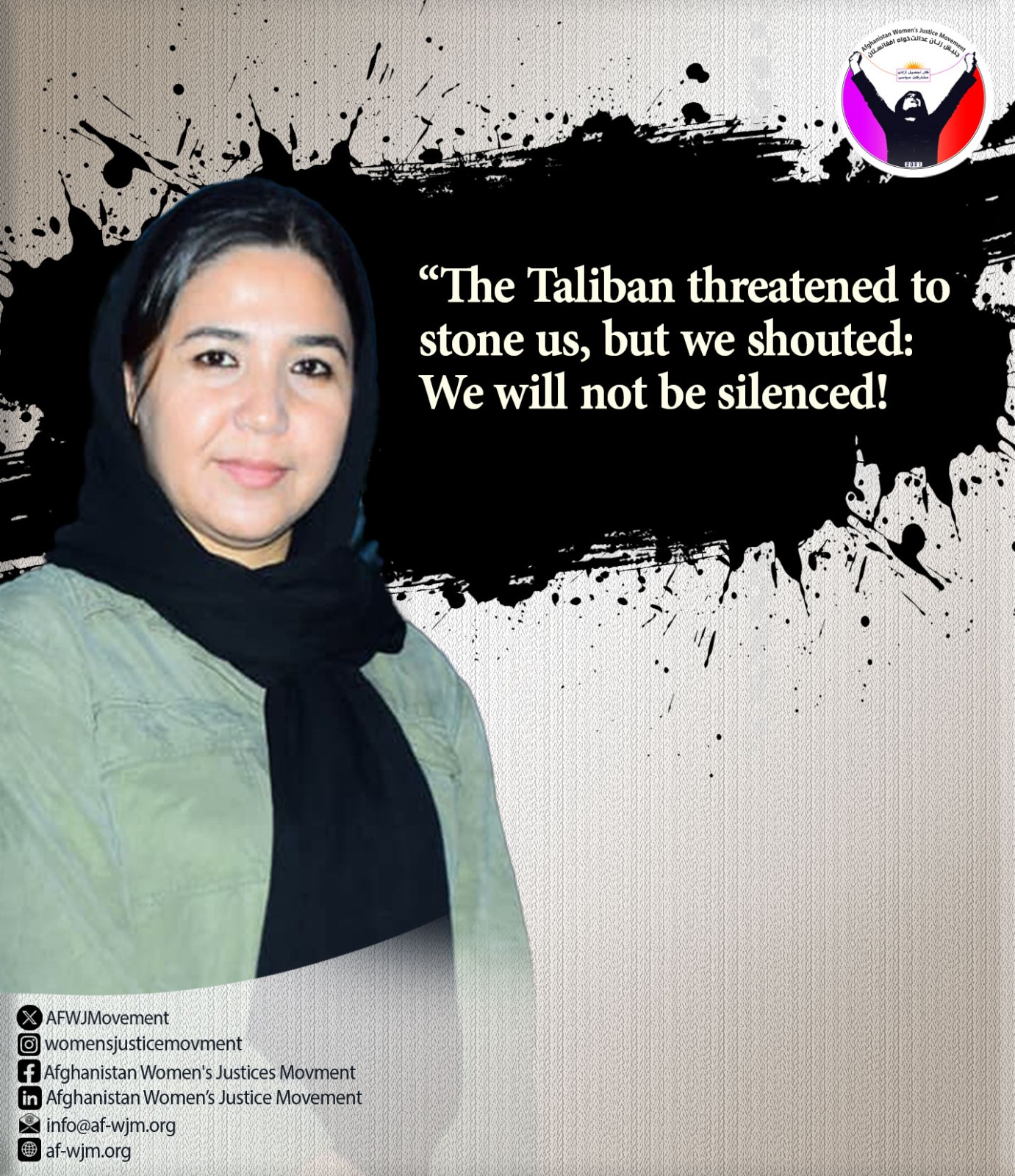
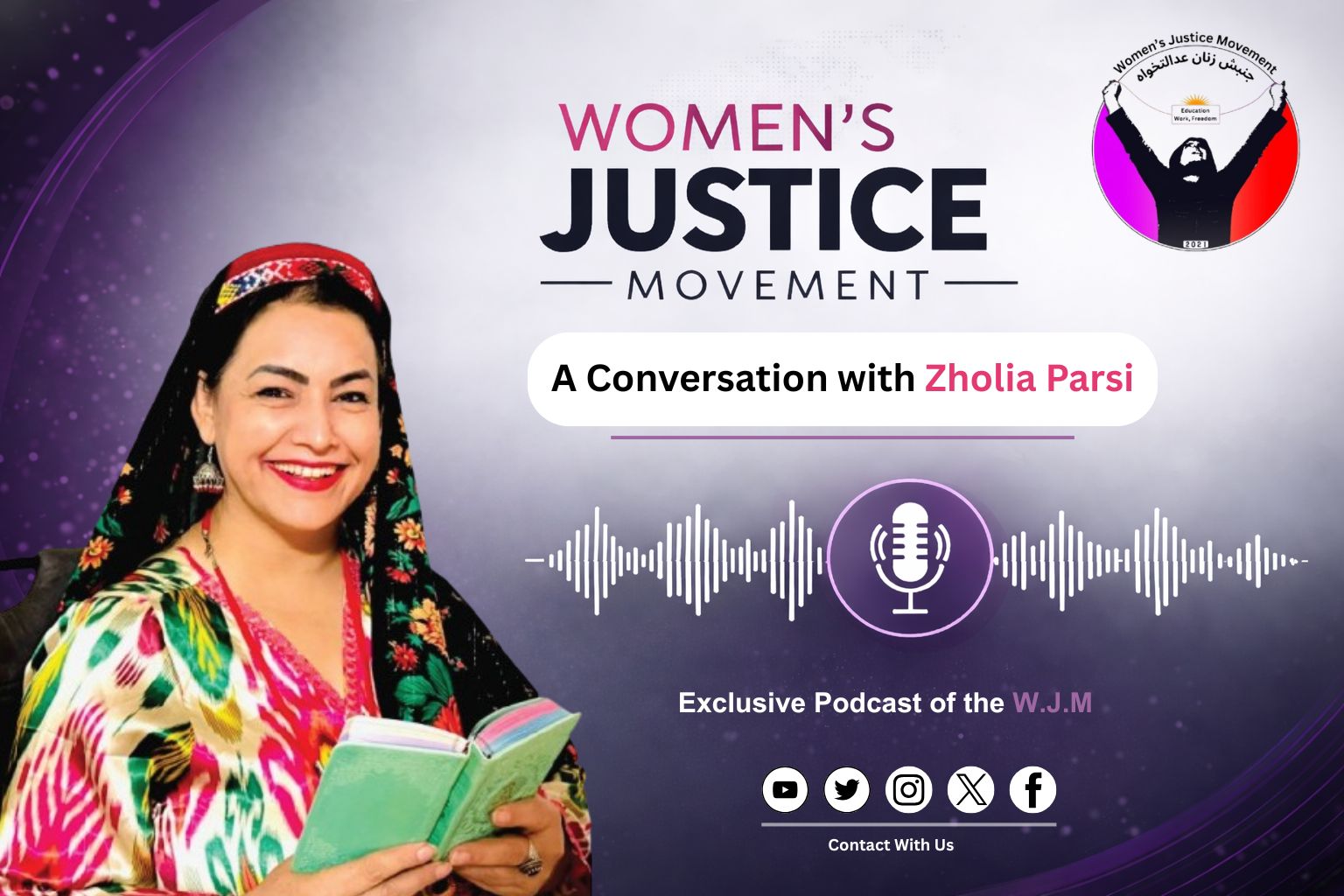
Jolia Parsi is among the prominent women who, following the Taliban's return to power, has represented the voice of protest and the demand for justice for Afghan women. She was arrested for her civil activism and paid a heavy price, yet she remains steadfast in her advocacy for women's rights to freedom, education, and a dignified life. In this conversation, we hear from her about her life’s journey, her experience in detention, and her perspective on the current status of women in Afghanistan.
Women’s Justice Movement: Ms. Parsi, please tell us about your personal background and your life’s path.
Jolia Parsi: I am Julia Parsi, a protester who previously served for 16 years in the education sector during the Ghani administration as a teacher, principal, and headmistress. In the final year before the government was handed over, I worked as the Executive Director of the Advisory Board at the High Council for National Reconciliation. I studied for fourteen years and graduated in Persian Literature from the Teacher Training College of Takhar Province. I am married and the mother of five wonderful children.
WJM: What factors drove you toward civil activism?
Jolia Parsi: I had a history of social and cultural activities during the administrations of Hamid Karzai and Ashraf Ghani. However, after the Taliban takeover—with the closure of schools and universities, the banning of women from their jobs, and the restrictions imposed by the Taliban—I felt I had to do something to be the voice of Afghan women. This led me to join protests with my friends, and on September 3, 2021, we launched our first street protest in Kabul.
WJM: What were you doing at the time of the fall of Afghanistan, and how did these changes affect your life?
Jolia Parsi: At the time of the fall, I was working at the High Council for National Reconciliation. I was in the office when the terrible news of the Taliban’s arrival reached me; it was a massive shock. I didn't know what to do or how to get home. I reached home with a thousand difficulties. On the way, seeing people in such a state of panic, terror, and distress, I lost my own sense of composure. It had a deeply negative impact on me. It was hard to imagine that as a woman, I could no longer work in society, and as a mother, I could no longer help my children achieve their dreams. My world felt filled with darkness and a sense of hopelessness.
WJM: The first time you decided to protest publicly against the Taliban's restrictions, what was going through your mind? And has there ever been a moment when you regretted your path?
Jolia Parsi: The first time I decided to stand publicly against this terrorist group, I was thinking: why should educated, knowledgeable women who worked and gained experience for twenty years be confined to their homes like prisoners? My own daughter, who dreamed of studying to become a judge, or my younger daughter, who wanted to be a politician and reach high office, could no longer do so. Like my daughters, thousands of others had aspirations that were all destroyed. All of this led me to stand and protest.
I have never regretted the path we took, even during the days I was in prison. On the contrary, in prison, I felt a sense of pride that I was able to stand against a group that does not want women to exist. They feared me even inside the prison, let alone when I protested in the streets. The Taliban are afraid of the word "Woman." This was a source of pride for me, and I have no regrets.
The role of Afghan women in this second period of Taliban rule has been vibrant and bold. Women took to the streets and showed the Taliban's true face to the world. This has prevented the Taliban from being recognized for nearly five years and has even led women to refer them to the International Criminal Court for arrest warrants. This is a great role and a great honor.
WJM: Can you share more details about the day you and your son were arrested? How did the Taliban treat you?
Jolia Parsi: When they arrested me, I felt as if I were a major mafia boss, given the number of armed men and vehicles they sent for me. They handcuffed me and placed a black hood over my head. They did the same to my son, who was working in the market; they blindfolded and handcuffed him in front of his friends as if he were a murderer, a smuggler, or a dangerous criminal. They treated both of us very poorly.
At the time of my arrest, there were no female officers with them, nor did they have a warrant. When I entered the prison, they searched me inappropriately, took my phone, and forced me to give them my password.
Human beings do not treat other human beings the way the Taliban treated us in prison. It is clear that when a woman is handcuffed and blindfolded in public, many questions arise in the minds of the people. I was a fighter and a protester; I had my pride and knew why I was being arrested, but my dignity was trampled before my neighbors even knew what my "crime" was. The mistreatment in public had a very negative psychological impact, and I still cannot forget the scene of my arrest. The eyes of all the neighbors were fixed on me, even though I had lived in that neighborhood with honor for years. I still wonder what they must have thought. I was arrested for protesting an oppressive regime, not for a crime or an immoral act. This is a deep wound on my soul that I will never forget.
WJM: While in prison, what were you most worried about?
Jolia Parsi: When I was arrested, they took my phone. I was worried about the girls in the chat groups I had with other protesters—fearing their numbers would fall into the Taliban's hands and they would be arrested too. My other worry was my family; I didn’t know if they knew where I was. I was distressed about my mother, my brother, and my children. I was especially worried about my son, who was also imprisoned and being tortured. When I finally saw him after forty-some days, seeing his condition—his clothes, his long hair and beard, and how thin he had become—it was devastating.
Overall, I was worried about everything related to me: from the movement and the protesting girls to my family and my daughters, whom they used to threaten me. They told me that if I didn't accept their demands, they would forcibly marry my daughter to their soldiers. I wasn't just facing one worry; I was under pressure from several directions.
WJM: After your release, how did your understanding of "freedom" change?
Jolia Parsi: After being released, my understanding of freedom became deeper and more painful. Freedom is not just being outside the four walls of a prison. Freedom means the right to work without fear, to speak without threat, and to live without humiliation. When freedom is taken from a person, you realize the immense value of the simplest choices: your clothes, your education, your voice. After my detention, freedom is no longer just a slogan for me; it is a responsibility that must be stood for, even if the price is heavy.
WJM: Do you feel that the price you paid was worth continuing this struggle?
Jolia Parsi: If I said this path had no cost, I would be lying. But if I said I regret it, I would be betraying myself and all the women who stood on this path. Freedom and human dignity do not come cheap. I paid a price: I went to prison, I was tortured, and I lost the security of my home, but I did not lose my voice. For me, the fact that an Afghan girl knows she is not alone makes every cost worth it. I am proud to have sacrificed for this struggle.
Today, my biggest concern is the "normalization" of oppression—the idea that the youth or society might accept the exclusion of women as an inevitable reality of Afghanistan. If the absence of women in society becomes normalized, that tragedy is deeper than any prison or lash.
WJM: Why do you think the Taliban fear the voices of women so much? And how effective do you see the role of the media in reflecting the struggle of Afghan women?
Jolia Parsi: The Taliban know that a woman's voice exposes their false legitimacy. A protesting woman is a reminder that the Taliban do not represent the people. A woman who asks questions, protests, and makes demands shakes the foundations of Taliban ideology.
The media can be either a lifesaver or a partner in forgetting. Wherever the media reflected the voices of Afghan women without censorship or simplification, we became stronger. However, media silence is a dangerous form of complicity with oppression. Fortunately, over these nearly five years, many media outlets have stood with us and amplified our voices to the world.
WJM: What new responsibility does receiving an international human rights award bring to you? Are these awards truly capable of protecting women inside Afghanistan, or are they mostly symbolic?
Jolia Parsi: These awards are not a personal honor for me; they are a commitment. A commitment to be the voice of protesting women and girls deprived of education and work, even if the cost is heavy. I remain bound to that oath.
If they end only with a photo and a ceremony, they are symbolic. But if they lead to political pressure, support, and holding the Taliban accountable, they can be a tool for protection. The true value of these awards depends on the actions that follow them.
WJM: Do you have a specific message for the men of Afghanistan?
Jolia Parsi: My message to the men of Afghanistan is that the freedom of women is not a threat to men. Manhood lies in standing for justice, not in silence against oppression. Without conscious men, this struggle is not complete. Instead of accusing protesting women of "case-building," fleeing, or taking money, stand beside them. Just as the people of Iran stood together to defend their rights, stand together to gain the individual freedoms you lack in Afghanistan. Instead of insulting protesting women, stand by their side.
WJM: Do you still see hope for change inside Afghanistan?
Jolia Parsi: My hope comes from the women who are still learning, thinking, and resisting. As long as one woman in Afghanistan has not surrendered, change is possible. I believe in this freedom that will return to Afghanistan soon, brought by the brave women of this land.
Closing:
We thank the dear Julia Parsi for sharing her time, experiences, and perspectives with the audience of the Women’s Justice Movement website. Her narrative is a testament to the bravery of Afghan women and the continued struggle for human rights and freedom.
Interviewer: Zarifa Salangi
Share: