A new report by the United Nations Special Rapporteur on the situation of human rights in Afghanistan documents the systematic expansion and institutionalization of discriminatory policies against women and girls under Taliban rule.
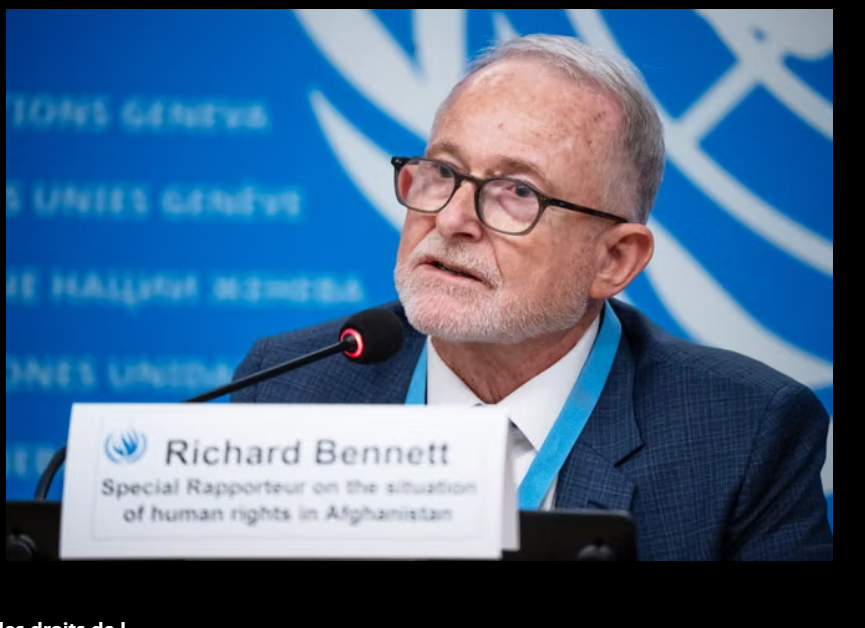
Richard Bennett, the United Nations Special Rapporteur on the situation of human rights in Afghanistan, presented his latest report at the 63rd session of the UN Human Rights Council. The report states that over the past five years, the Taliban have progressively introduced and enforced discriminatory policies that have severely restricted the fundamental rights and freedoms of women and girls across almost every area of public life.
The findings indicate that these restrictions are not isolated decisions, but form part of a broader and increasingly institutionalized system of gender-based discrimination. The adoption of the so-called **Law on the Promotion of Virtue and Prevention of Vice in 2024**, alongside new judicial regulations introduced in 2026, has further formalized this system.
The Systematic Exclusion of Women from Public Life
According to the report, since returning to power, the Taliban have gradually restricted women's participation in Afghan society.
Freedom of movement, access to education and employment, participation in public life, access to services, and freedom of expression have all been affected by increasingly restrictive policies.
Women have faced requirements concerning male guardianship for travel, restrictions on transportation and air travel, compulsory dress codes, and bans or limitations on their access to parks, gyms, public baths, beauty salons, and other public spaces.
Richard Bennett warns that restrictions on women's movement have consequences far beyond personal freedom. They can also prevent women from accessing essential services, including healthcare, placing their health and lives at greater risk.
Education: A Generation Being Denied Its Future
The report once again identifies the exclusion of girls and women from education as one of the most serious human rights violations in Afghanistan.
Following the Taliban takeover, secondary schools for girls remained closed despite initial promises that the closures would be temporary. Universities were subsequently closed to women and girls, and their access to many other educational institutions was also restricted.
In December 2024, the restrictions were extended to medical and health-science education, effectively preventing women from training as nurses, midwives, laboratory technicians, and other health professionals.
The continuation of these policies threatens not only the fundamental right to education of millions of Afghan girls and women, but also the future of Afghanistan's professional workforce and public services.
Restrictions on Women's Right to Work
The report also documents the growing exclusion of women from employment.
Many female government employees have been forced to remain at home or have faced severe restrictions on their employment conditions. In some cases, their salaries have been significantly reduced despite their qualifications and years of professional experience.
Women working in the non-governmental sector have also faced increasingly severe restrictions. The Taliban suspended women's employment in national and international NGOs and subsequently prevented women from working in UN offices across Afghanistan.
The closure of women's beauty salons also resulted in the loss of livelihoods for thousands of women and had significant economic consequences for families dependent on these businesses.
The Virtue and Vice Law: Institutionalizing Restrictions
A central concern highlighted in Bennett's report is the Taliban's Law on the Promotion of Virtue and Prevention of Vice.
According to the report, the law brings together and institutionalizes many restrictions that had previously been imposed through individual decrees and instructions.
Compulsory dress requirements, restrictions on women's presence in public spaces, male-guardian requirements, restrictions on women's voices in public, and extensive monitoring of citizens' behavior are among the measures documented.
The establishment of provincial offices responsible for enforcing the law, together with their broad enforcement powers, has made the implementation of these restrictions more coordinated and systematic across the country.
Erosion of the Rule of Law and Access to Justice
The report also raises serious concerns about the dismantling and transformation of Afghanistan's legal and judicial institutions.
The Taliban have dissolved or fundamentally altered judicial structures that existed under the former government. The Attorney General's Office, for example, was abolished and replaced with an institution focused on monitoring and enforcing the Taliban leader's decrees.
Judges appointed during the previous government—including hundreds of women judges—were removed from their positions. The independence of the Afghan Independent Bar Association was also undermined, while women's participation in the process of obtaining legal licenses has been restricted.
According to Bennett, these developments have weakened access to justice and undermined fundamental principles of fair trial and the rule of law.
Corporal Punishment and Executions
The report documents the return and expansion of public executions and corporal punishments under Taliban rule.
Since 2021, the Taliban have resumed public executions and punishments such as flogging. These measures have been applied to various offenses, including what the Taliban classify as “moral crimes.”
Bennett states that such practices raise serious concerns regarding Afghanistan's human rights obligations and the principles of due process and fair trial.
Restrictions on Freedom of Expression and the Media
Freedom of expression and media activity have also come under increasing pressure.
The Taliban have introduced various regulations controlling media content and restricting the publication of material deemed contrary to their interpretation of Islam or critical of Taliban authorities.
Political programming has faced additional restrictions, while mechanisms have been introduced to review and control media content.
Female journalists face additional barriers, including stricter dress requirements, restrictions on appearing in programs with male presenters, and limitations on their professional activities.
These restrictions affect not only journalists but also the wider public's right to access information freely.
Restrictions on Culture, Art, and Sport
The report also highlights the Taliban's restrictions on cultural and social life.
Music, artistic activities, cultural traditions, and women's participation in sports have all been subjected to restrictions.
Female athletes have faced severe limitations and, in some cases, have been forced to leave Afghanistan in order to continue their professional careers.
These policies have deprived women and girls of opportunities to participate in cultural and sporting life and have further isolated them from public society.
Religious Restrictions and Discrimination
The report further raises concerns about restrictions on freedom of religion and belief.
According to Bennett, the Taliban's emphasis on a particular interpretation of Islamic law and Hanafi jurisprudence has narrowed the space available to religious minorities to practice their beliefs freely.
Legal and family-related regulations may also disproportionately affect women belonging to religious minorities, particularly Afghan Shia communities.
A Systematic Pattern of Exclusion
Taken together, Richard Bennett's findings present a picture of interconnected restrictions that, over the past five years, have progressively excluded women and girls from almost every sphere of public life.
From education and employment to freedom of movement, media, culture, sports, religion, and access to justice, the restrictions have continued to expand, with many now embedded within formal laws and institutional structures.
The Women’s Justice Movement expresses deep concern over the continuation of these policies and emphasizes that the systematic exclusion of women and girls is not an ordinary domestic policy matter, but a profound violation of their fundamental human rights.
Denying an entire generation access to education, employment, freedom of movement, public participation, and justice also places Afghanistan's future at risk. A society cannot achieve sustainable peace, development, or justice while half of its population is systematically excluded.
We believe that documenting these violations and amplifying the voices of Afghan women and girls is a shared responsibility of civil society, human rights organizations, and the international community. Silence in the face of systematic discrimination risks allowing the exclusion and repression of women to become normalized.
The right to education, the right to work, the right to freedom, the right to participate, and the right to live with dignity are fundamental human rights. Afghan women are not an exception.
Women’s Justice Movement
Share: