Between Suppression and Exile:
The Fate of Afghan Women Protesters in the
Cycle of Threats and Forced Return
2026
This investigative report has been prepared through a joint collaboration between Femena and the Afghan Women's Justice Movement, drawing on interviews conducted with 12 sources. Following the collapse of the Republic on August 15, 2021 (24 Asad 1400), a major portion of Afghanistan's legal and protective frameworks dissolved, and citizens' fundamental rights were severely restricted. In this environment, women became more vulnerable than any other group, driven from the center of society into the confines of their homes. Women and girls lost their right to freedom, choice, self-determination, and many other fundamental rights, with secondary education even being banned for girls. This situation drove a number of women—who had grown up believing in human rights values and had been active within legal, political, and civil society frameworks—to take to the streets in protest. These demonstrations were primarily witnessed in Afghanistan’s major cities, such as Kabul, Herat, and Balkh.
This report examines the fate of women protesters after challenging Taliban policies, as well as the current living conditions of those who fled to Iran and Pakistan to escape these threats.
Six active women protesters were interviewed for this report: four have experienced living in Pakistan; one was deported back to Afghanistan from Iran; and one was recently relocated from Pakistan to a third country. Another woman continues to live in Afghanistan under constant Taliban threats.
Exile Without Security
The threats directed at active women and protesters by the Taliban caused hundreds of women to flee to Iran and Pakistan after 2021 to secure their safety. Due to the high level of threats, a number of these women were forced to leave Afghanistan secretly and illegally. Zarifa Salangi is one of these women; she crossed the border into Iran illegally in 2022, wearing a chadari (burqa) to conceal her identity.
Interviews with women in this report reveal that several protesters were forced to take their children along on the perilous and illegal journey to Pakistan—a circumstance that multiplied the hardships of the trip.
Shahla Arefi, a women's rights activist and leadership member of the Afghan Women's Justice Movement, notes that after being released from a Taliban prison in Kabul, she spent time under unofficial house arrest and permanent surveillance. During one of the group's raids, she states:
"I was severely injured in the neck and required immediate medical care and stitches to treat it."
The escalating risks and Taliban threats against Ms. Arefi and her family members eventually forced her to leave Afghanistan in September 2023 and seek refuge in Pakistan—a country she assumed would provide her with at least temporary security.
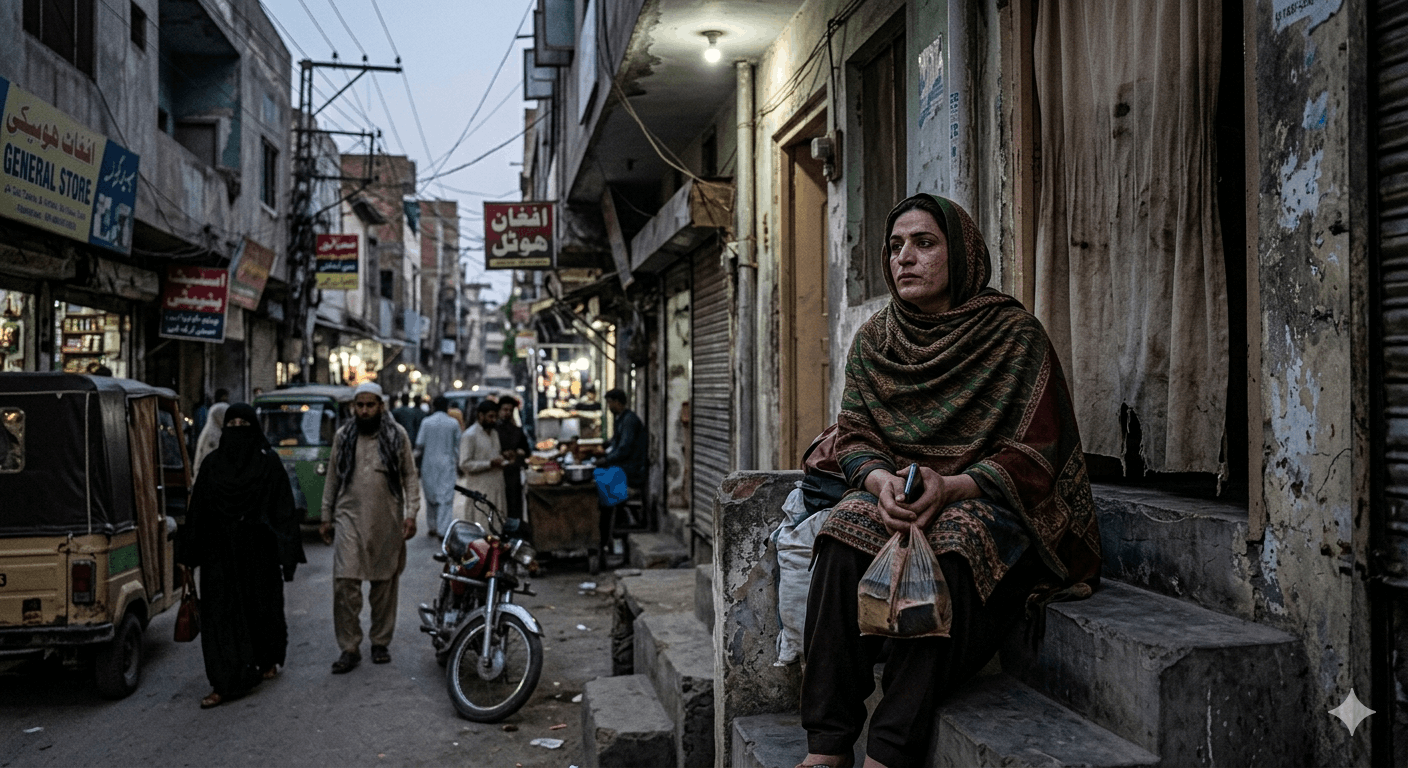
The accounts of the women in this report demonstrate that even after fleeing Afghanistan, the protesters did not find the peace they were seeking; instead, violence extended into their lives in other forms. In Pakistan and Iran, due to the lack of legal residency documents, they spend their days and nights in constant anxiety and fear of detention. A number of participants have also experienced detention, harassment, and violence at the hands of the host country's police.
The lack of access to the labor market in host countries has been another factor placing double pressure on women protesters, leaving them in severe financial distress.
Shahla Arefi states:
"My family of eight and I have no fixed or stable source of income. Due to existing restrictions, accessing suitable job opportunities is extremely difficult for us."
This situation has turned the heavy costs of house rent, food, medical care, transportation, and other basic needs into an unbearable burden on her and her family's life.
The difficulty of securing basic living necessities—which Ms. Arefi must shoulder alone—coupled with anxiety over the safety of her husband, who was recently deported back to Afghanistan, has left her in a highly vulnerable state. This predicament has caused her to face heightened anxiety, depression, a sense of insecurity, and permanent worry regarding her family's future.
Zarifa Salangi also describes her living conditions in Pakistan as grueling, stating that the lack of a visa keeps her in perpetual dread of being detained and deported back to Afghanistan. During an interview with *Ravi-e Zan* (The Woman Narrator), Ms. Salangi said:
"Right now, as I am answering your questions, news reached us that our house is scheduled to be searched by the police tomorrow, and we had to move at twelve o'clock tonight to another house, without even knowing who it belongs to."
For a long time, Ms. Salangi has not even gone outside to buy bread, relying instead on a roommate who holds a valid visa. Her fear of the consequences of deportation to Afghanistan is so severe that whenever police arrive to inspect the house, she hides inside the kitchen cabinets.
Detention, Camps, and Deportation
Three of the participants in this report have experienced detention by the host country's police.
Khadija Haidari, who was detained by Pakistani police in Peshawar on April 21, 2025, states:
> "It was not clear at all what their objective was. They just said, 'Come to the camp.' They didn't even allow us to take our belongings. They said, 'Leave your things, you will return and surrender.'"
During her 24 hours in detention, Haidari was only allowed to hold her mobile phone for five minutes, which had **1%** battery charge.
> "I left one message and it turned off. Then they said, 'It's off, now go.'"
When Ms. Haidari was detained in Pakistan and transferred to the camp, she faced harsh conditions; she had no access to edible food and was kept in poor sanitary conditions. She notes:
> "Everything was in the same place. Shaving, washing hands and face, washing clothes, and the toilet were all together—extremely dirty and broken down."
Interviewees state that they also faced violence from security forces inside the camps.
> On the second day of their stay at the camp, security forces shoved and punched Ms. Haidari's husband right in front of her eyes, simply because he left his room to ask for his phone.
Interviews with women who experienced detention indicate that both male and female police officers took turns humiliating the migrants.
On the second night in the camp, a female police officer entered the room where Ms. Haidari was being held, shouting and conducting body searches on everyone. She searched all the detainees' belongings to ensure no one had brought a phone. This officer went as far as searching Ms. Haidari's bra, screaming at her about what she was hiding underneath; upon realizing it was money, she finally left her alone.
The situation in specialized migrant camps in Iran mirrors these accounts. Maryam Azizi, one of the interviewees in this report, notes that after visiting the relevant departments in Iran to follow up on her residency status, she received a deportation notice from the police ordering her to leave Iran by a specific deadline.
Ms. Azizi was also subjected to mistreatment:
> "We were not treated with respect or human dignity, and an environment was created where we felt fear, helplessness, and insecurity. Harsh verbal confrontations and psychological mistreatment placed immense pressure on us."
During her arrest and camp stay, Maryam Azizi’s mobile phone was confiscated, leaving her with no means of communication. Consequently, she was unable to contact friends, family, or a lawyer, and her family had no knowledge of her whereabouts.
The holding conditions in the detention center were substandard for Ms. Azizi. She says:
> "Sufficient and proper food was not provided to the detainees, and sanitation was at a very low level. Overcrowding doubled the problems. There was no sense of security in the detention center, and people were constantly worried about their health and safety."
Ms. Azizi was given no opportunity to appeal the deportation decision or apply for asylum, preventing her from effectively presenting her security concerns and the dangers of her return to Afghanistan to the camp officials.
The Peril That Follows Women Post-Return
The participants in this report residing in Pakistan stated that due to their advocacy work for women's rights and protests against the Taliban's repressive policies, they face escalating threats in Afghanistan. Should they return, they face the risk of arrest, imprisonment, torture, and death.
Zarifa Salangi states:
> "Since I participated in demonstrations and have been fighting against the Taliban for nearly five years, if I am returned to Afghanistan, I will be arrested by the Taliban on charges of apostasy, undermining the Islamic system, improper hijab, and so on."
Salangi adds that based on her knowledge of the Taliban's conduct, she knows that returning to Afghanistan means arrest, public lashing, stoning, and execution.
> "My punishment is definitely death; nevertheless, I am not afraid of the Taliban. The Taliban should be afraid of me. However, I feel it would be a waste to be killed by a terrorist group."
Despite this, Ms. Salangi continues her life in Pakistan every day under the shadow of detention fears, persistent anxiety, sleep deprivation, and non-stop nightmares.
Shahla Arefi shares a similar narrative. She notes that if deported to Afghanistan, her history of human rights, civil, and women's rights advocacy would guarantee her arrest, torture, and death. Living under these conditions has had a devastating psychological impact on the women protesters. Arefi says:
> "These conditions have left deep impacts on my physical and mental health, as well as those of my family members."
Farahnaz Ebrahimi (pseudonym)—another protester against the Taliban's repressive policies who fled to Pakistan with her four-year-old child in July 2022 after being released from a Taliban prison—states that returning to Afghanistan would once again expose her to the risk of arrest and imprisonment.
Following the Taliban's takeover of Kabul in 2021 and the imposition of restrictions on women and girls, Ms. Ebrahimi joined other women protesters, taking to the streets to demand justice and defend women's rights. This activism put her under direct threat from the Taliban. After participating in several rallies and protest marches, she and her four-year-old child were arrested and imprisoned by the Taliban, where she was also subjected to physical beatings.
Like several other women protesters, Ms. Ebrahimi was forced to give a coerced confession upon her release from prison, taking blame for crimes she did not commit. She was also forced to sign a commitment stating she would no longer campaign against the Taliban. However, Ms. Ebrahimi notes that after her release, she resumed her human rights activities and continued to protest against the Taliban’s oppressive policies.
Ms. Ebrahimi, who currently resides illegally in Pakistan, speaks of her profound fear of forced return:
> "If I am deported to Afghanistan, my life and my son's life will be in grave danger, and I worry about facing arrest and serious threats again. If the Taliban arrest me this time, they will bury me alive or execute me in a summary trial."
Ms. Ebrahimi's anxieties are shared by all women protesters who lack official residency documents and face the constant threat of detention and deportation from Pakistan.
Under the Shadow of the Taliban Threat
The fear of return raises another crucial question: why do these women firmly believe that returning to Afghanistan will result in arrest, torture, or death? The narratives in this report indicate that the answer lies in the firsthand experiences these women endured after protesting Taliban policies.
Shahla Arefi, who worked for the Ministry of Women's Affairs during the Republic era, states:
> "I continued my activism as a member and leader of the Afghan Women's Justice Movement. I played a role in organizing, coordinating, and leading more than forty protest movements and civil activities in Kabul and several other provinces."
Ms. Arefi defines the objective of these activities as defending women's fundamental rights, including the right to education, the right to work, fundamental freedoms, and human equality.
Advocacy for women's rights and protesting the Taliban's repressive apparatus has carried a heavy price tag for these protesters—ranging from threats to arrest, imprisonment, and torture. Ms. Arefi was repeatedly threatened, intimidated, and harassed by Taliban intelligence forces. She received multiple warnings from Taliban security agencies that if she did not halt her civil and human rights activities, she would face arrest, imprisonment, torture, and even death.
Continuous pressure and threats forced several women protesters to flee Afghanistan; for many of them, Pakistan and Iran were the only accessible destinations to seek refuge.
Living Between Fear and Anticipation
The interviewees, whether currently residing in Pakistan or still living in Afghanistan, all share one common thread: a daily experience of restriction, dread, and psychological violence. For those still in Pakistan, the lack of official residency documents, an uncertain future, the perpetual fear of arrest and deportation, and vague hopes for tomorrow have left them in a state of total suspension—as if the normal flow of life has stopped for them.
The interviewees in this report identify economic hardships, constant fear of detention or forced deportation, difficulties renewing residency documents, limited access to employment opportunities, obstacles receiving healthcare, restrictions on children's education, discrimination against refugees, lack of adequate social support, relocation difficulties, psychological insecurity, severe mental strain, an undefined future, housing difficulties, and the continuous rise in the cost of living as the decisive factors that have stripped all meaning from their lives.
Ms. Arefi notes that despite living under harsh conditions in Pakistan, she has not lost hope and believes that justice, human dignity, and freedom are values worth standing up for.
> "I hope that my voice and my family's voice are heard, and that an opportunity is provided for us to live in security, freedom, human dignity, and enjoyment of fundamental rights; an opportunity to restart life, far from fear, threats, and harassment."
On the other hand, the protesters urge the international community to stand by Afghan women and secure dignified living opportunities for them in safe countries. Ms. Salangi states regarding this:
> "At least assist and grant asylum to those who have a three-to-four-year track record of work and sufficient documentation, rather than deciding based on the personal tastes and preferences of certain individuals. Please exercise greater precision."
Farkhunda (pseudonym), one of the protesters against the Taliban's repressive policies who still lives in Afghanistan, narrates a deeper suffering:
> "Living under the canopy of the Taliban cannot be called living; because life encompasses many concepts such as social welfare, freedom, and the right to education. The absence of these takes away the meaning of life."
Farkhunda explains that because she is being pursued by the Taliban, she can neither enter the job market nor operate freely in society; hence, life currently holds no meaning for her. She describes her life as being on hold, constantly wondering what will ultimately happen to her. With anxiety and helplessness, she asks:
> "I am always thinking, what will happen in the end? Where are we headed? Is there a way to breathe freely as a human being or not? I cannot find any satisfying answer to this question."
Financial incapacity has made living in Afghanistan difficult for Farkhunda, while simultaneously stripping her of the ability to afford migration costs. She states that if she had the financial means, she would have at least sought refuge in one of the neighboring countries to escape the fear of being arrested by the Taliban.
The women interviewed in this report, whether in Afghanistan or Pakistan, were driven onto this hazardous path by a shared motivation: defending women's rights and protesting the repressive policies of the Taliban. Today, all of their lives remain suspended. Only Khadija Haidari has managed to secure asylum in an African country and begin dreaming of her future. The prolongation of this lifestyle has brought devastating psychological consequences, turning constant fear and anxiety into a fixed component of these women's lives.
Somaya Behboudi, a psychologist, states:
> "When someone flees from personal oppression, it means they have been sufficiently traumatized and have experienced a mix of various emotions like fear and anxiety simultaneously."
However, she notes:
> "When this person flees to a place where, despite expecting sanctuary, they are bound to increase their anxiety with suffering and fear, another source has been added to their trauma and pain."
According to Ms. Behboudi, new wounds have been added to these women's lives before their previous ones could heal. Living on high alert due to the fear of being detained by security forces has created permanent anxiety in them. Ms. Behboudi adds that helplessness is another emotion these women likely experience, as they now find themselves in a situation where they cannot truly live in their new environments of Iran or Pakistan. The continuation of this state drives individuals toward depression.
Despite the perils confronting women protesters in Afghanistan, the Pakistani government continues to detain and deport them, ignoring the international principle of non-refoulement (no forced return).
Fereshta Abbasi, a researcher for the Afghanistan division of Human Rights Watch, told *Ravi-e Zan* that the Pakistani government lacks any political will to protect those Afghan citizens whose security is endangered under Taliban rule, or who may face mistreatment, arbitrary detention, and torture.
According to Ms. Abbasi, Human Rights Watch has documented cases where the Pakistani government detained and deported Afghan migrants despite them holding valid visas. She adds that currently, Afghan asylum seekers in Pakistan can only prevent their deportation by bribing police officers during arrests or while being held in camps.
Meanwhile, according to Human Rights Watch, some women were arrested and tortured by Taliban forces immediately after being deported by Pakistan. Ms. Abbasi notes that the threats currently facing women human rights defenders in Afghanistan could escalate to target killings and enforced disappearances.
Given these circumstances, what is the responsibility of women's rights and human rights advocacy organizations toward women at risk?
Zubaida Akbar, Head of Afghanistan Programs at the human rights organization Femena, states that the Pakistani government must respect its international commitments, particularly the principle of *non-refoulement*, and cease deporting women protesters and women human rights defenders who face severe security threats if returned to Afghanistan. In her view, countries that maintained a political and military presence in Afghanistan over the past twenty years, as well as countries pursuing a feminist foreign policy, bear a responsibility to provide safe pathways, visas, and asylum options for women at risk—including human rights defenders, women protesters, and women who worked within former government structures.
Ms. Akbar also stresses that human rights organizations must advocate for these women's access to visas and resettlement in safe countries. Until relocation is finalized, donor agencies must provide financial support to enable them to live with dignity, given that many of these women are living in desperate conditions with their children and families without any source of income.
Furthermore, the United Nations High Commissioner for Refugees (UNHCR) offices across various Pakistani cities could halt deportations to Taliban-controlled Afghanistan by accelerating these women's asylum applications and providing them with valid residency documentation.
Exact figures regarding the exodus of Afghan citizens to Iran and Pakistan are unavailable, as a large portion of these movements occurred illegally and went unrecorded. Nevertheless, according to a United Nations report published on May 19 of the current year, nearly **5,900,000** Afghan citizens have returned or been returned to Afghanistan from Iran and Pakistan since September 2023. The report adds that in the first four months of the current year alone, 600,000 individuals entered Afghanistan.
The women's narratives in this report demonstrate that protesting Taliban policies did not conclude upon exiting Afghanistan; rather, it led to protracted insecurity, exile, and limbo. Violences and threats have persisted for them in Pakistan and Iran under newer guises, blending these women's lives with a sense of insecurity, fear, and anxiety, while keeping them suspended between a longing for freedom and the ambiguous hope of achieving it. Rather than being worried about the personal security consequences of their protests, these women are concerned about a future they might never live to see—a future where all Afghan women can live freely. As Zarifa Salangi puts it, her fear of returning to Afghanistan is the dread of missing the day of liberation and the longing to "dance with hair flowing free in the wind."
Femena supports women human rights defenders, their groups and organizations, and feminist movements in the MENA region and Asian countries. Femena’s focus is on countries where civil society spaces are shrinking or closing, as well as countries impacted by conflict and extremism.
Femena's objective is to raise awareness regarding the impact of regional developments on women, feminist movements, and civil society organizations. Femena's national and regional reports offer a comprehensive analysis of developments in the region, particularly trends that result in the restriction of women's rights and the targeting of feminist movements.
The Ravi-e Zan (The Woman Narrator) media outlet is the product of the effort and commitment of a group of female journalists and writers. Witnessing the choking oppression and suffocation imposed on Afghan women by the Taliban, they resolved to launch the operations of this media outlet in September 2022.
The policy of *Ravi-e Zan* is explicitly transparent: to provide comprehensive support for the lost rights of women and to deliver accurate, objective, and impartial coverage of current events in the country. It operates independently, free from the influence or control of any domestic or foreign entities, driven solely by its understanding of media ethics and mission.
The Women's Justice Movement (WJM) is an independent, women-led organization registered in Norway, operating with the objective of defending human rights, justice, gender equality, and supporting the women and girls of Afghanistan.
Share: