Part Two
Author: Hamia Naderi
After the fall of King Amanullah’s government, Afghanistan’s political structure entered a period of gradual transformation, though one marked by profound challenges. Political stability and the preservation of social cohesion became two central pillars of state policy. From this perspective, women’s rights were no longer introduced as a sudden shock but were instead pursued through a slow and gradual process.
This period guided first by Mohammad Nadir Shah, followed by Mohammad Zahir Shah, and later shaped by the premiership of Mohammad Daoud Khan and the drafting of the first modern constitution reflected a cautious yet pragmatic policy aimed at harmonizing modernization with the traditional fabric of Afghan society. Within this framework, maintaining the acceptance of religious scholars and local power structures was considered essential for the survival of the monarchy and the central state.
From the early 1950s through the 1960s, the government’s approach toward women leaned more toward preserving social cohesion than introducing rapid or sweeping change. Mohammad Nadir Shah, who sought to consolidate power and secure the support of religious leaders and local commanders, adopted measures that outwardly aligned with religious and traditional sensibilities.
During this period, the veil remained a symbol of traditional social identity, and women’s publications and organizations such as Irshad al-Niswan and the Kabul Women’s Association were temporarily suspended or restricted in their activities. This cautious policy was designed to prevent widespread opposition and to preserve the state’s social capital. It demonstrated that modernization in Afghanistan could not proceed outside the framework of royal authority or without accommodating the power dynamics of traditional institutions.
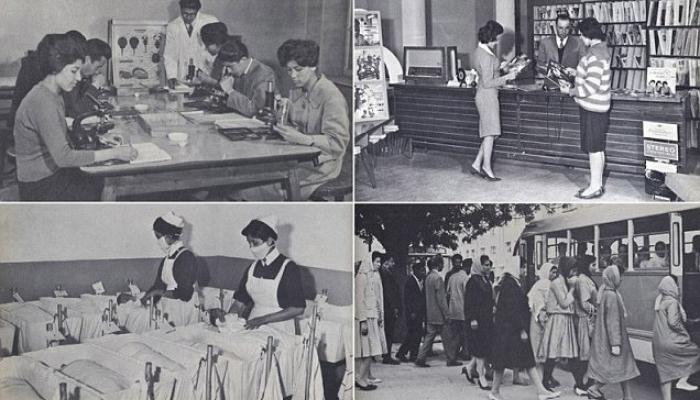
However, with the consolidation of royal authority in the 1960s, the political atmosphere gradually opened. During the premiership of Mohammad Hashim Khan, the king’s uncle, girls’ schools reopened often allowing students to attend while wearing the chador rather than enforcing stricter forms of seclusion. Educational opportunities for women expanded particularly in the fields of health and nursing.
This gradual step was largely motivated by the need to improve public health and reduce maternal mortality. It illustrated how modernization could be linked to tangible social functions. Young women began entering not only classrooms but also hospitals and health centers, shaping professional roles as nurses, midwives, and health workers. Although these changes were visible in major cities, a deep geographic and social gap between urban centers and rural areas remained.
In this context, the voluntary unveiling initiative of 1959 became a significant turning point. Implemented cautiously through symbolic public modeling, events such as military parades were attended by Queen Humaira Begum, Bilqis Begum, and Zainab Begum, the wife of Mohammad Daoud Khan, without traditional veiling.
The event provoked strong reactions from some religious scholars, who issued letters of protest. However, Mohammad Daoud Khan avoided engaging directly with the criticisms, arguing that Islamic law did not prescribe a single obligatory form of veiling. The government presented the move as a symbolic step toward opening public institutions, universities, and healthcare centers to women.
While this development reflected the state’s intention to redefine the administrative and educational body of the country, it also triggered strong moral and religious opposition from traditional sectors of society. Nevertheless, women’s presence with more visible public roles within state institutions gradually became a social reality, creating new opportunities for education and employment.
The 1960s marked another milestone with the adoption of the new constitution in 1964. This constitution formally recognized equal rights within the sphere of political citizenship and expanded the possibility for women’s active participation in public and political life. For the first time, women engaged in politics and public affairs gained official recognition.
During the twelfth parliamentary elections, four women entered the Afghan parliament: Ruqia Habib Abu Bakr, Anahita Ratebzad, Khadija Ahrari, and Masuma Esmati Wardak. Their election symbolized the entry of women into national decision-making spaces.
Masuma Esmati Wardak later became the first female minister in Afghanistan’s history. These developments were not only recorded as legal achievements but also as symbolic milestones marking women’s entry into positions of power during Afghanistan’s modern era.
At the same time, women began working as broadcasters at Radio Afghanistan, and their voices reached cities and villages across the country through national media. Yet these achievements were largely concentrated in the capital and major urban centers, while deep class and geographic divisions were already becoming visible by the early 1960s.
The reality of life for women in rural and remote areas remained shaped by deeply rooted tribal and traditional structures. Contemporary statistics indicated that despite legal progress, approximately seventy-eight percent of the country’s rural population continued to live in traditional environments with limited access to quality education, adequate healthcare, and suitable employment opportunities.
This deep social and geographic divide became one of the underlying conditions for future conflicts in later decades. Historically, it played a decisive role in shaping the country’s political and social developments.
During this period, the central government’s cautious policy became an important experience in the history of Afghan women: reforms that advanced gradually through the modern legal framework of the constitution while acknowledging local social limitations. From a historical perspective, this gradual strategy conveyed two important messages. First, modernization without acknowledging the country’s social fabric and without cooperation with traditional power networks could not be sustainable. Second, although women’s rights were formally recognized within the framework of citizenship, their practical implementation remained constrained by deep cultural barriers.
The outcome of this period can therefore be seen as a combination of promise and limitation: the promise of equal political rights and women’s presence in national decision-making spaces, alongside the practical limitations faced by a large segment of rural society and women embedded within traditional social structures.
This inevitable tension, particularly in the decades that followed, contributed to deeper social conflicts and periodic redefinitions sometimes gradual, sometimes abrupt of women’s place within the structures of power. Yet the fundamental point of this era remains clear: the process of modernization in Afghanistan began through a policy of caution and through interaction with traditional forces, gradually moving toward a national legal framework.
At the conclusion of this section, an important question arises: did this gradual path toward women’s rights lead to broader equality, or would it continue to face deep cultural conflicts and disparities between urban and rural women? The answer becomes clearer in the following sections, where the transformations after 1973 reveal both the consequences of these achievements and the limits that accompanied them, offering a broader map of women’s narratives, history, and politics in Afghanistan.
Share: