Examining the Status of the Persian Language, the Taliban’s Language Policies, and Their Impact on Afghanistan Cultural and Linguistic Identity
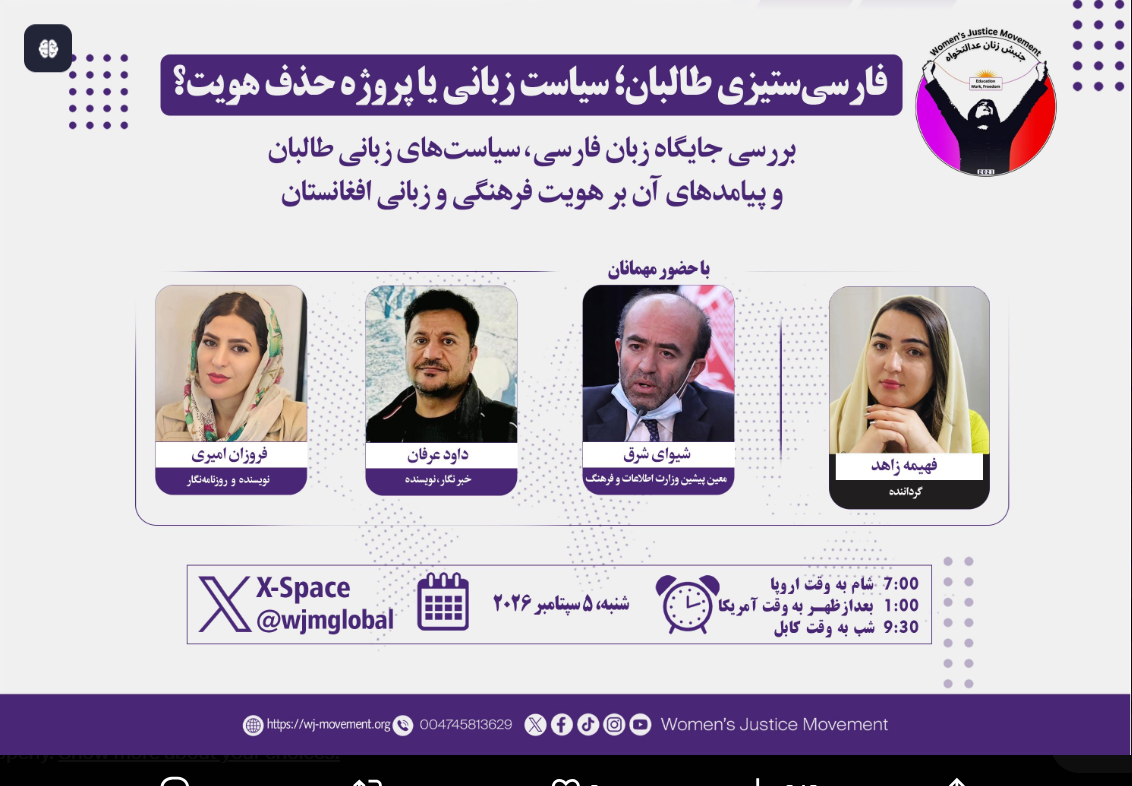
A discussion titled “Taliban’s Anti-Persian Policies: Language Policy or a Project of Erasing Identity?” was held with the participation of writers, journalists, and cultural experts. The program examined the historical status of the Persian language in Afghanistan, the Taliban’s language policies, and the consequences of restricting and gradually marginalizing Persian on the country’s cultural and linguistic identity.
The discussion addressed the Taliban’s recent approaches toward the Persian language, including concerns over attempts to alter names and terminology, replace Persian words, modify public signs, and limit the use of Persian in official and educational institutions.
Participants emphasized that language is not merely a means of communication; it is an essential part of a society’s collective memory, culture, identity, and shared heritage.
The guests of the program included:
* Shiva-ye Sharq, former Deputy Minister of Information and Culture;
* Dawood Erfan, journalist and writer;
* Forouzan Amiri, writer and journalist;
* Fahima Zahed, moderator of the discussion.
Throughout the conversation, participants explored a fundamental question: Can the Taliban’s actions against the Persian language be viewed merely as language policy, or are they part of a broader project aimed at weakening, erasing, and redefining Afghanistan’s cultural identity?
The speakers highlighted the historical significance of Persian in Afghanistan, stressing that the language has long been one of the fundamental pillars of the country’s civilization, literature, culture, and collective historical memory. They argued that restricting or marginalizing Persian cannot simply be regarded as an administrative or linguistic change.
Participants also expressed concern about the broader consequences of the Taliban’s language policies, warning that imposing linguistic uniformity and suppressing cultural diversity will not strengthen social cohesion. Instead, such policies risk deepening existing cultural and identity-based divisions within Afghan society.
The discussion further emphasized the importance of preserving Afghanistan’s linguistic diversity and respecting the native and historical languages of all communities. Participants argued that protecting the Persian language means protecting an essential part of Afghanistan’s history, culture, and shared identity, and that no government should use language as a tool for exclusion, discrimination, or the engineering of identity.
The event comes amid growing concerns over increasing restrictions on the Persian language and gradual changes to Afghanistan’s cultural and educational landscape. Cultural activists and defenders of linguistic rights have warned that silence in the face of policies of exclusion and cultural homogenization could lead to the loss of important parts of Afghanistan’s historical and cultural heritage.
Through facilitating this discussion, the Women’s Justice Movement seeks to create space for critical dialogue on language, identity, and the Taliban’s cultural policies, while amplifying the voices of writers, journalists, and cultural activists advocating for linguistic diversity, cultural justice, and the protection of Afghanistan’s shared heritage.
Share: