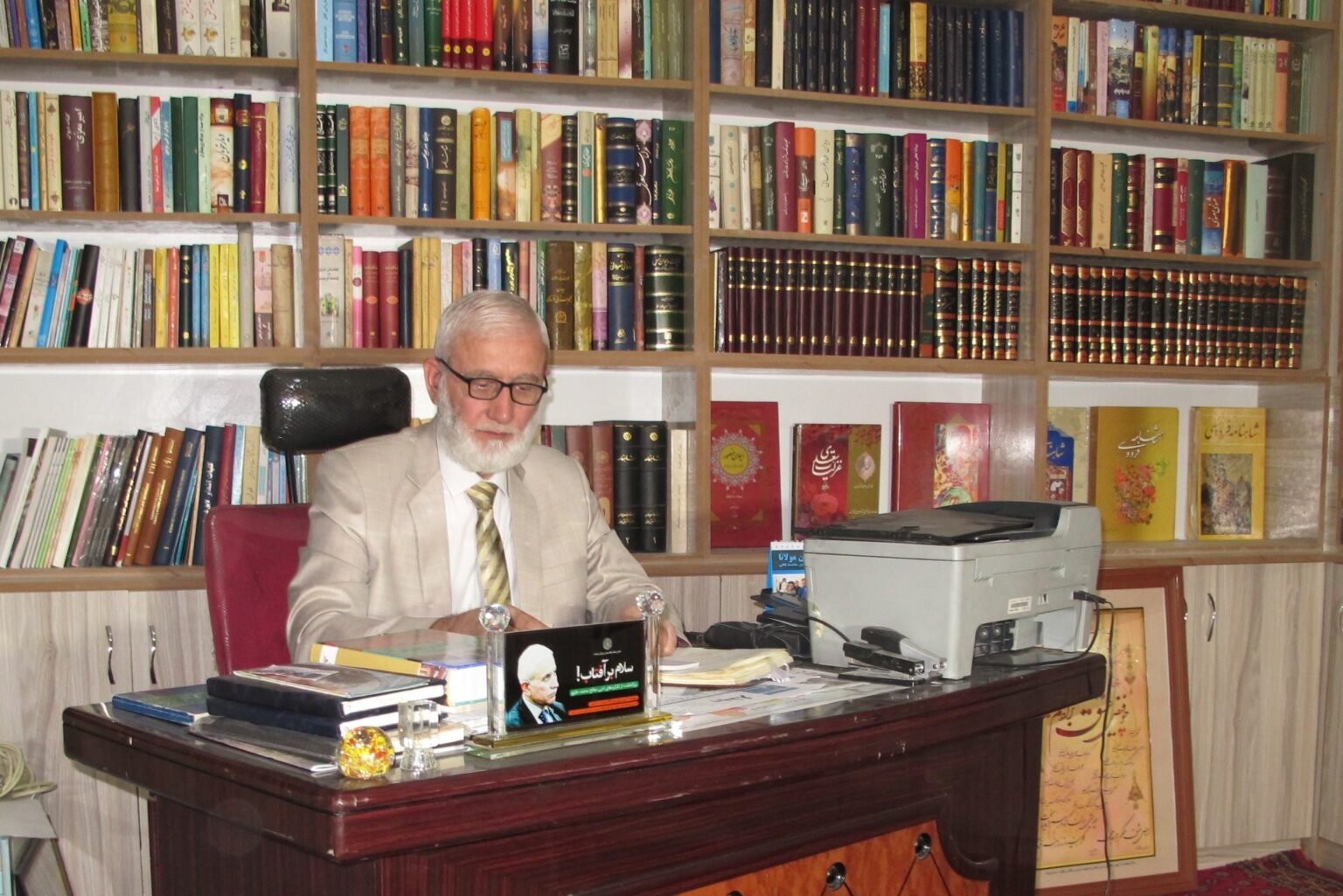

In the tumultuous history of contemporary Afghan literature, Saleh Mohammad Khaliq (1955–2025) stands as a towering figure—a poet, scholar, and local intellectual from Balkh who played a pivotal role in preserving Afghanistan’s cultural heritage and national identity. Viewing himself as a “guardian of the nation’s historical memory,” Khaliq used poetry, research, and cultural activism to resist the social and political crises that plagued Afghanistan. Amid war, migration, and the Taliban’s dominance, his unwavering commitment to the Persian language and human values left an enduring legacy.
Biography: From Mazar-i-Sharif to the Pinnacle of Literature
Born in 1955 in Mazar-i-Sharif, the heart of Balkh’s historical civilization, Saleh Mohammad Khaliq pursued Persian literature at Balkh University and later earned a master’s degree from Payame Noor University in Iran. In the 1970s, while working at a fertilizer factory in Mazar-i-Sharif, he began his literary journey, quickly emerging as a prominent cultural figure.
During the turbulent 1980s and 1990s, Khaliq channeled his efforts into cultural resistance. In 1990, he founded the Balkh Writers’ Association, which became a vibrant hub for writers, poets, and intellectuals in northern Afghanistan. He led the association until his tragic death in a car accident in Mazar-i-Sharif on July 29, 2025. His passing sparked widespread mourning among Afghanistan’s cultural community and beyond, with tributes hailing him as the “Scholar of Balkh” and “Guardian of National Memory.”
Khaliq’s Poetry: A Fusion of Tradition and Innovation
Saleh Mohammad Khaliq’s poetry bridges the classical traditions of Persian literature with modern innovation. His refined, rhythmic, and vivid language explores themes of Balkh’s identity, resistance, love, and social suffering. In his work, Balkh is not merely a city but a symbol of civilization, history, and lost grandeur. Collections such as In the Bamiyan of My Heart and Along the Silk Road exemplify his masterful use of geographic and cultural imagery.
With a philosophical and mystical lens, Khaliq portrayed love as a transformative force, weaving words like “sun,” “mountain,” and “star” to elevate readers’ minds to profound concepts. Simultaneously, his poetry reflected collective pain. Works like Lament of the Red Rose and From Fresh Wounds vividly capture the scars of war, migration, and injustice. His accessible yet eloquent style made him a voice for the people, echoing Afghanistan’s tradition of resistance poetry that flourished after the 1960s amid political and social crises.
Notable poetry collections include Greetings to the Sun, Tall Green Pine, From Blue Heights, A Sky of Stars, The Last Frontier of Infinity, The Thrill of the Soul, Words of Love, In the Famine of Affection, and On the Path of Ghuchis. These works cement Khaliq’s place in Afghanistan’s literary resistance movement.
Scholarly Contributions: Reconstructing Balkh’s Identity
Beyond poetry, Khaliq was a dedicated scholar who believed that understanding local history and culture was essential for national identity. His research, grounded in archival, fieldwork, and oral history methods, preserved Balkh’s rich heritage. His extensive body of work spans literature, journalism, archaeology, folklore, and tourism.
Key scholarly works include:
• Aryan Festivals (Balkh, 1991)
• Eagle (Tehran, 1996)
• Cry for Freedom: A Study of Allama Sayed Ismail Balkhi’s Poetry (Balkh, 2005)
• History of Balkh’s Literature from Ancient Times to the Early 21st Century (Kabul, 2008)
• History of Journalism in Balkh (Tehran, 2010)
• Kiani Melody (Kabul, 2013)
• Mirror within Mirror: Criticism and Commentary (Kabul, 2015)
• Archaeological Sites and Historical Monuments of Balkh (Tehran, 2015)
• The Impact of the Shahnameh on Afghanistan’s Resistance Poetry (Tehran, 2016)
• Traces of Bukhdi’s Past Glory (Balkh, 2018)
• Tourist Attractions of Balkh (Kabul, 2020)
• Messenger of Light and Compassion (Balkh, 2021)
These works not only documented Balkh’s cultural and literary history but also revitalized discourse on Afghan identity.
Cultural and Media Activism
From 2004 to 2020, Khaliq served as the Director of Information and Culture for Balkh Province. During this period, he spearheaded transformative projects, including establishing public libraries, supporting artistic associations, and restoring historical sites. He also fostered active engagement with local and international media.
As editor-in-chief of publications like Umm al-Bilad, Bidar, and Kiyan, Khaliq created platforms for cultural dialogue, social critique, and public awareness. His participation in international conferences in Iran, Tajikistan, India, France, Poland, Turkey, and the United States showcased Afghan culture globally. As a member of cultural organizations such as the Maulana, Nasir Khusraw, Peyvand, and Amir Ali Shir Nava’i associations, he exemplified successful cultural diplomacy.
Khaliq and Afghanistan’s Transformations
Amid Afghanistan’s turbulent history—from civil wars to the Taliban’s resurgence—Khaliq emerged as a beacon of cultural resistance. Through the Balkh Writers’ Association, he provided a space for intellectuals to counter historical and cultural erasure. His poetry and research reflected the collective struggles of war, migration, and political oppression, while advocating for the preservation of Afghan identity.
Conclusion
Saleh Mohammad Khaliq, the poet, scholar, and cultural luminary of Balkh, was a rare embodiment of intellectual and social commitment. By blending art, scholarship, and activism, he became a model for local intellectuals. His literary and scholarly works remain a treasure trove for reimagining Afghanistan’s cultural identity. In an era when Afghanistan grapples with ongoing political and cultural challenges, Khaliq’s legacy offers inspiration and guidance for future generations seeking to revive their heritage.