Over the past several years, women in Afghanistan have stood up against discrimination, violence, and systematic exclusion from various spheres of social and political life. With the return of the Taliban and the expansion of sweeping restrictions on women and girls, this struggle has entered a new phase, one in which women’s protests and resistance have come at a much higher cost, but have not been silenced.
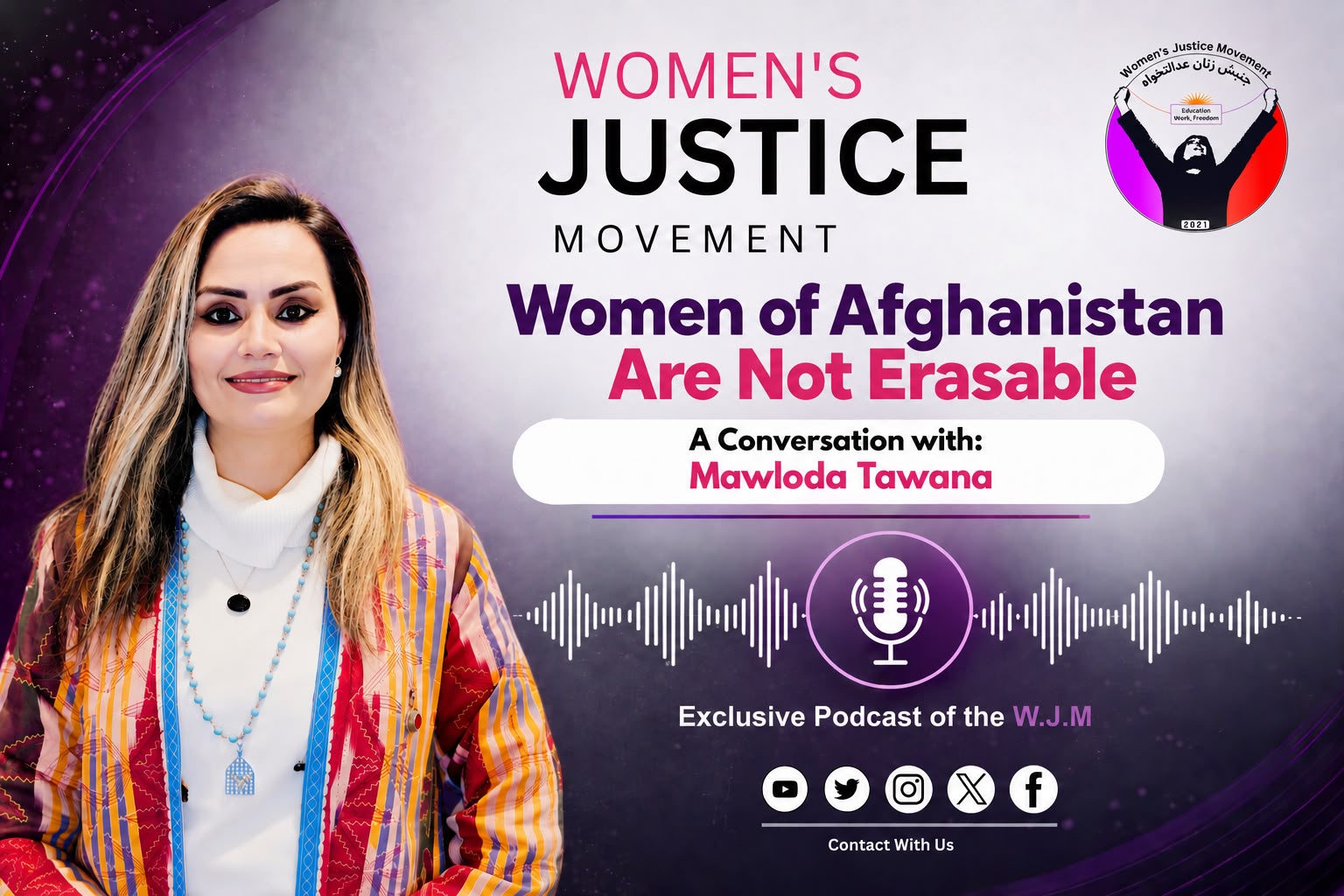
Mawluda Tawana is a longstanding women’s rights and civil society activist in Afghanistan who has spent years working in the fields of gender equality and social activism. Alongside her civil society activities, she also has experience working within Afghanistan’s former government structures. Following the country’s political transition, she continued her activism and advocacy for women’s rights.
In this interview, we asked her about her life and activism, her experience in civil society and government, the situation of women in Afghanistan, women’s protest movements, the role of the international community, and the future of the struggle for freedom, justice, and equality.
Women’s Justice Movement: Ms. Tawana, to begin our conversation, please introduce yourself to the audience of the Women’s Justice Movement’s website. Tell us about your background, education, and the path that led you to social activism and the defense of women’s rights.
Mawluda Tawana: Greetings and heartfelt respect to you and the Women’s Justice Movement, which has fought tirelessly and exceptionally for years in the field of human rights and all the rights that women have lost. I thank you.
I am Mawluda Tawana, a human rights and gender equality advocate. I have been active in this field for many years, particularly in the area of gender equality. Alongside this work, I am the leader and founder of the Movement of Progressive Forces of Afghanistan.
I have 15 years of work experience within Afghanistan’s government structures. During the Republic, I served in senior expert positions, as an adviser to ministries, and as a director-general of one of the departments in the gender sector, as well as in other important areas.
Regarding my education, I hold a diploma in Political Science. I was also a master’s student at the Faculty of Law and Political Science, studying International Relations. Unfortunately, I was unable to continue my studies after the Taliban came to power. As you know, all universities, schools, and educational institutions were closed to women and girls.
As for the path that led me to social activism, I may have already discussed it in many of my previous interviews and conversations. When I had just graduated from school, I was already a teacher and was teaching, while also being a member of Afghanistan’s civil society. I regularly attended its meetings and programs, particularly urban programs focusing on civic responsibilities and obligations.
My social activities date back to 2012 and even earlier. I was active within Afghanistan’s civil society, and I can say that a significant part of my social activism began and took shape there.
Regarding my background in social activism and defending women’s rights, and how I entered this field, to be honest, part of it comes down to an individual’s personal characteristics. I found the spirit of struggle within myself. I felt that this spirit was in my being, in my blood, and even in my genes. I was never someone who could remain indifferent to the issues unfolding in Afghanistan. This, in a way, compelled me to make an effort, struggle, and stand firm.
Although I was a mother and had many responsibilities, motherhood itself is a major responsibility. Alongside that, continuing my education, working, and becoming active in society were not easy. However, I managed to overcome all these challenges. I had a very strong motivation to struggle within me, one that I may not be able to explain fully. But this motivation helped me find my place and encouraged me to think differently from many other women and strive to achieve my goals.
Women’s Justice Movement: What experience or event in your life led you to decide to become seriously involved in social activism and advocacy for women’s rights?
Tawana: Undoubtedly, we have lived in a country where, unfortunately, prejudice and discrimination have run through the blood, veins, and very fabric of society. Inequality has existed even in educated families and among families with high levels of knowledge, both in society outside the home and within the family. All these circumstances have caused us to experience deprivation.
As I explained earlier, these injustices made me pay greater attention to the issue and decide to work on it more seriously. I wanted to say “no,” at least in the face of all the prejudices, discrimination, inequalities, and social injustices that Afghan women have endured for years and that have prevented them from participating in activities and working.
Although I married at a very young age, became a mother, and was away from education and studies for some time, these very inequalities and difficulties motivated me to stand up again, continue my education, and take on several responsibilities simultaneously. Fortunately, I succeeded in this journey.
That is why the motto I have always lived by, and one I often share with my children and friends, is: “Nothing is impossible; sometimes, you are the ones who make something impossible to justify yourselves.” This belief gave me the strength to achieve the goals I had set for myself.
Women’s Justice Movement: You have experience working both in government institutions and in civil society. What have you learned from these two experiences, and how has your perspective on women’s issues differed between these two periods?
Tawana: If we honestly examine Afghanistan’s civil society, it was one of the institutions that played a very significant role in raising public awareness and consciousness. Its activities were extensive throughout Afghanistan, particularly in Kabul, and many of its programs and models were also used in other provinces.
Numerous programs were organized on cultural enrichment, awareness-raising, and social issues. These activities played an important role in increasing public awareness and consciousness. Therefore, the activities of Afghanistan’s civil society cannot be separated from the process of raising awareness among women and empowering them.
Regarding my own work within Afghanistan’s government structures, I should say that I held relatively senior managerial and executive positions. There were also many differences in that environment. My experience within Afghanistan’s government structures was very extensive and significant. However, unfortunately, I also encountered numerous challenges and difficulties, and I witnessed and experienced many of these issues firsthand.
If we compare civil society with Afghanistan’s government structures, there were many differences. In civil society, people generally worked voluntarily, based on shared beliefs and common goals. Conferences, meetings, workshops, and various programs were organized through cooperation and mutual understanding.
However, within Afghanistan’s government structures, resources were unfortunately not available to the extent expected, and prejudice and discrimination were particularly severe in some government institutions. During my service in various ministries, I witnessed extremely serious cases.
Unfortunately, Afghanistan’s government structures did not demonstrate the level of accountability they should have. I am making this statement in general terms, and I do not exempt myself from that system either. Although I did not hold a very high-ranking position, I was in a managerial and executive role. Therefore, I do not think it would be right for us today to completely absolve ourselves and claim that we had no role in what happened.
What had been entrusted to us was, in many cases, not given the attention it deserved within Afghanistan’s government structures. Over the years, we had numerous reports concerning prejudice, discrimination, inequality, and injustice against women. In addition, administrative corruption, financial corruption, and even moral corruption were widespread in government offices.
Despite all these contradictions, problems, shortcomings, and managerial and structural weaknesses, there were also achievements in women’s presence and participation during the Republic that cannot be ignored.
Although some of this participation was symbolic, it was nevertheless significant that women had managed to secure a place for themselves to some extent. Women were present in the media, the defense and security sectors, the judiciary, legal institutions, and other fields. Women also played roles in Afghanistan’s parliament and other important institutions.
Many organizations were also working to promote women’s development and empowerment. Although some of these activities were project-based, they nevertheless created opportunities that some women were able to benefit from and even helped provide employment opportunities for other women.
We cannot deny the reality that, despite the many challenges and the violence women experienced, opportunities for women’s employment, social participation, and presence within institutional structures had been created to some extent.
Women’s Justice Movement: Looking back on your years of activism, what do you consider the greatest achievement and, on the other hand, the greatest failure of Afghanistan’s women’s protest movements?
Tawana: Regarding the failures of Afghanistan’s women’s protest movements, I must first make one point very clear: following the collapse of Afghanistan’s government, the women’s protest movements were among the most important movements to bring the situation in Afghanistan to the world’s attention. They showed the world the conditions in Afghanistan and how Afghan women are fighting for freedom, equality, and justice.
Women struggled for their lost rights, fought, made sacrifices, were imprisoned, killed, disappeared, and subjected to various forms of violence.
If Afghanistan experiences freedom and a better life again in the future, a large part of that will be owed to the resilience and struggles of Afghan women. Afghan women have been one of the reasons why the Taliban have not been officially recognized by the international community to this day.
On the other hand, unfortunately, we are now witnessing the world’s indifference toward the situation of the people of Afghanistan, particularly women. However, the strength I see in the current activities of women’s protest movements is that they have managed to show the world the true face of the Taliban and the situation of Afghan women.
Regarding their weaknesses, it was unfortunately expected that these same protest movements would form a large, unified umbrella following the collapse of the government, with a clear policy framework, a shared vision, and a collective program. The emergence of any movement opposing Taliban ideology is commendable and worthy of respect. However, in my view, these movements could also have worked together under a single umbrella.
Unfortunately, this did not happen. Internal weaknesses and the lack of unity among women prevented the formation of such a unified platform. To this day, we have yet to see a cohesive and powerful structure led by women that the international community can turn to for an understanding of the situation of Afghan women.
My experience has been that, following the collapse of Afghanistan’s government, women’s protest movements went in different directions and followed different paths. They were unable to preserve their unity, regardless of what central structure might have been established. As a result, unfortunately, we have still not managed to establish such a unified umbrella.
Women’s Justice Movement: In your view, what characteristics should a genuine and sustainable women’s movement have, and where is the line between such a movement and symbolic, short-term activism?
Tawana: Given all the transformations Afghanistan has experienced throughout its history, the country has witnessed women’s protest movements in different periods. These movements date back many years, and women such as Dr. Anahita and other Afghan women activists played a role in the formation and expansion of women’s movements. They were the ones who opened doors and paved the way for subsequent activities.
Fortunately, today we are witnessing a growing number of women’s protest movements. However, in response to your question, I believe that an important characteristic of a sustainable movement is that it should operate according to a strategy and policy centered on the people and citizens, a strategy rooted in the demands of all Afghan citizens.
Such a movement should not focus solely on women’s issues. Rather, humanity and human rights should be at its center, encompassing all Afghan citizens, regardless of gender. It could even pursue values that are consistent with humanitarian aspirations at the global level.
If a movement possesses these characteristics and allows different individuals to find their place within it, it will no longer be limited exclusively to women’s issues. Instead, it can achieve much broader growth and a more prominent position.
Women’s Justice Movement: Some women activists believe that the international community has largely limited its response to the repression of Afghan women to issuing statements and condemnations. What specific and practical actions do you expect from the international community?
Tawana: I have always said in my discussions that we should never have placed too much hope in the international community from the beginning. Even today, what we see is that the world is mostly observing the situation in Afghanistan and sometimes limiting its response to issuing statements and written directives. The suffering of the Afghan people is not receiving the attention it deserves.
This situation shows that we must take action ourselves. The main decision-makers in changing Afghanistan’s situation are the people of Afghanistan, its young people, and the country’s informed and awakened generation, a generation that has endured bitter experiences, lost its homeland, and is now displaced in different parts of the world.
It is the people themselves who can determine the direction and build a free, prosperous, and brighter Afghanistan, not the international community, nor the countries of the region or the wider world.
For years, and in different periods, various countries have primarily pursued their own interests. We have experienced the presence of both the East and the West in Afghanistan, and neither was able to bring about the reconstruction and prosperity of the Afghan people to the extent expected.
Therefore, Afghan citizens must come to understand that they themselves must provide the path to liberation from oppression and take action to bring about positive change in Afghanistan. We should not always wait for the world, because relying on the world means placing our trust in those who, in many cases, have prioritized their own interests.
Women’s Justice Movement: In recent years, the term “gender apartheid” has increasingly been used to describe the situation of women in Afghanistan. Do you consider this term appropriate for describing their situation? If so, what actions should follow?
Tawana: Without a doubt, Afghan women are now in a situation that can be described as full gender apartheid. Afghanistan is currently the only country in the world where women face such widespread restrictions and deprivation.
I think there is hardly any worse situation left that Afghan women have not already experienced. This situation demonstrates that the issue of gender apartheid in Afghanistan must be taken seriously by countries that believe in human dignity.
Cooperation is needed to ensure that gender apartheid in Afghanistan is recognized and criminalized as a crime, and that it is formally acknowledged that gender apartheid has taken shape in Afghanistan.
The action expected from the awakened consciences of the region and from countries that believe in democracy, freedom, and equality must go beyond symbolic statements. We cannot expect fundamental change from those who have spent years primarily pursuing transactions and their own interests, including the United Nations, the United States, and other actors whose presence, in many cases, has been largely symbolic.
Women’s Justice Movement: Many Afghan women activists are now living in migration and exile. In your view, how can women activists outside Afghanistan maintain effective connections with women inside the country and represent their voices without overshadowing the voices of women inside Afghanistan?
Tawana: This issue requires a very comprehensive and long-term plan. We have nearly five years of experience with the Taliban’s presence in Afghanistan, and their rule has become increasingly harsh, with restrictions growing day by day.
Given the current global situation, the policies of regional countries, and their various approaches, we cannot say with certainty how long the Taliban will remain in Afghanistan or how much longer the people will have to make sacrifices.
Therefore, we must work on effective programs and mechanisms that can provide a way to continue education and support the development of the new generation if this situation persists for a long time.
My concern is not limited to girls. Boys in Afghanistan are also facing difficulties continuing their education. They are also being directed toward schools and environments where extremist and violent ideologies may be promoted instead of healthy education and upbringing. This could become a major challenge for the future and for generations to come.
We must work on ways to provide online education or any other possible form of learning. In my view, this is a very large project that cannot be undertaken by just one or two people.
Certainly, a number of institutions and organizations that support such programs must work together on a comprehensive mechanism and approach to create practical solutions, at least for girls who are currently deprived of education, and design programs that will also be effective in the future.
Women’s Justice Movement: One concern is that, as the current situation continues, the international community and even public opinion may become accustomed to the situation of Afghan women. What should be done to prevent this normalization?
Tawana: To prevent this situation, decision-makers in regional countries and around the world must put an end to this confusion and the current state of affairs. Alongside this, the people of Afghanistan must also have plans and programs and take action themselves to change the situation.
We have witnessed countries that have endured oppression, but whose people have risen from that very suffering and oppression to take action and change their circumstances.
I have always said that struggle requires sacrifice. One generation may have to make sacrifices so that the next generation can live, at least, in a relatively safe and humane environment. If we wait for the international community or regional and global countries to do everything, this outlook contradicts the goals we have for changing Afghanistan’s situation.
If the international community had demonstrated a serious commitment to changing the situation over these past five years, and if doing so had not conflicted with its interests, it would at least have taken some action. But today, we see that many countries assess and pursue issues concerning Afghanistan based on their own interests.
For this reason, the people of Afghanistan must consider how they can create a serious movement for change from within the country. Those living outside Afghanistan and in exile must also support this movement in any way possible, both financially and morally.
If changes and developments emerge from within Afghanistan and people come to believe that the time for action has arrived, they must not be left alone. They should receive as much support and cooperation as possible.
Women’s Justice Movement: If the Taliban continue their current policies in the coming years, how do you see the future of Afghanistan’s women’s protest movements? Will further repression silence the resistance, or will it give rise to new forms of struggle?
Tawana: In my opinion, the greater oppression becomes, the more people will eventually reach their breaking point. As the saying goes, “Those pushed to the limit will eventually fight back.” Ultimately, people will come to believe that if they are to live every day in fear and deprivation, perhaps it is better to stand up once for freedom and dignity.
I think people have already lost much of the patience, endurance, and tolerance they maintained over these past five years. Those of us outside Afghanistan, as well as those living inside the country, are each experiencing confusion, uncertainty, and difficult circumstances in different ways.
Women’s protest movements may become discouraged at certain times, but I do not think they will abandon the struggle. One of the fundamental objectives of these movements is to fight until they achieve their goals. As long as those goals remain unachieved, I do not think the protest movements will give up their struggle.
Women’s Justice Movement: With your many years of experience in social activism, what serious advice would you give to the new generation of Afghan women and girls who are facing restrictions and hopelessness today?
Tawana: Based on my experience over the years working in important government institutions and offices in Afghanistan, I would like to say something very briefly to the new generation, to Afghan women and girls, and to all Afghan people who are facing hopelessness today: ultimately, we ourselves are the ones who determine our own destiny.
If we bow under the weight of oppression, one regime may fall only to be replaced by an even worse one. Therefore, we must not allow hopelessness to overcome us. We must remain hopeful, committed, and steadfast.
If we truly want to play a role in changing Afghanistan, we must not overlook even the smallest injustice taking place in the country. We must stand against injustice and keep our voices of protest raised.
If the nation achieves full awareness and accepts that struggle entails costs and sacrifices, I believe that no system built on oppression and violence can last forever.
The new generation of Afghanistan must not so easily give up on its dreams, its aspirations for the country’s development, or its plans and goals. It must stand firm and remain hopeful, continue the struggle, and resist inequality and injustice in whatever way possible.
We sincerely thank Ms. Mawluda Tawana for accepting this interview and sharing her views and experiences with the audience of the Women’s Justice Movement’s website. We hope that the continuation of such interviews will help preserve the historical memory of women’s struggles, strengthen solidarity, and amplify the voices of women fighting for freedom, justice, and equality.
Share: